For Parents
CPM looks different from the math you remember — and that's intentional. This page explains how CPM works, why it works, and how you can support your student at home without needing to know every answer yourself.
Why CPM Looks Different
Study Teams
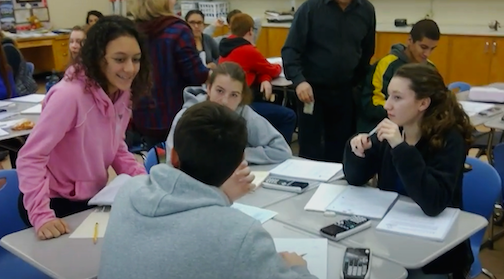
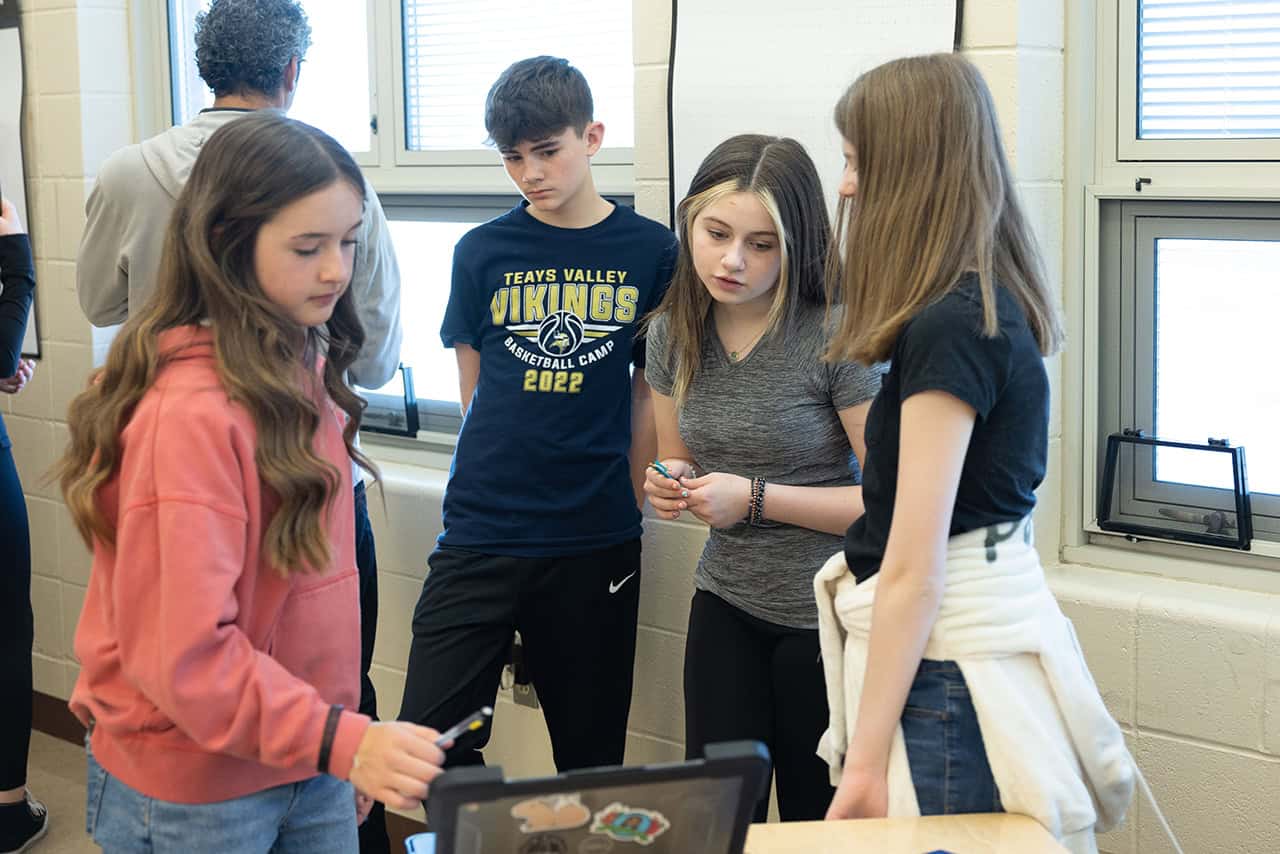
Students work in collaborative study teams of 2–4 every day. Teams are designed to encourage mathematical conversation — students explain their thinking, question each other, and build understanding together. Each student has an assigned role.
This is why your student might say "I learned it from my group" rather than "the teacher showed us."
Problem-Based Learning
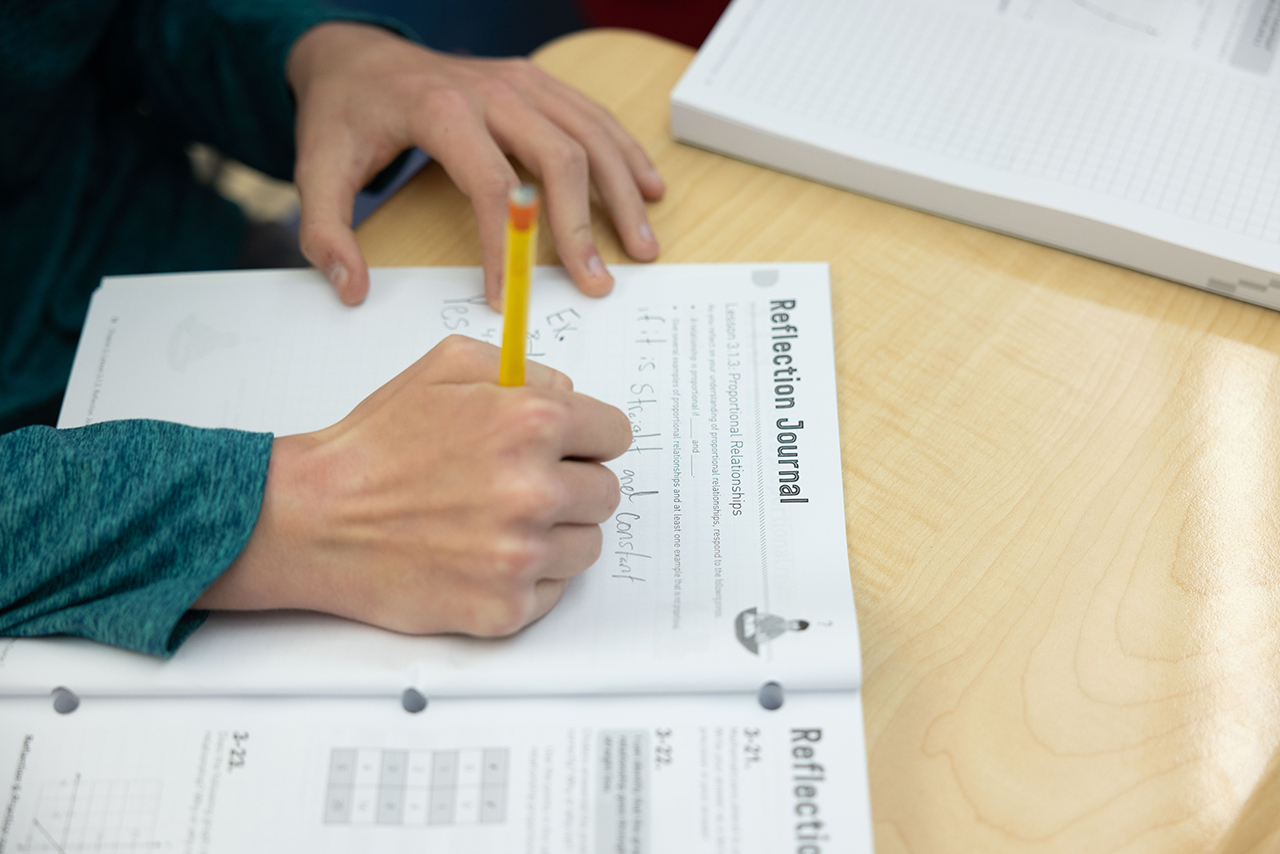
The teacher poses a big problem and then circulates — listening, asking questions, and guiding rather than lecturing. Students construct mathematical understanding by working through problems collaboratively.
This is why homework can feel hard — students are expected to try, not just reproduce a formula.
Mixed, Spaced Practice
Independent practice (“Review and Preview” in Core Connections and “Reflection & Practice” in Inspiring Connections) contains problems from multiple topics — not just tonight’s lesson. This interleaving is intentional: revisiting past material repeatedly leads to better long-term retention than blocked practice.
This is why homework doesn't always match the day's lesson — and why it works.
Your Best Starting Point
The Parent Guide is the most useful resource for helping your student with specific homework problems. It includes alternative explanations, worked examples, and additional practice for every topic in the course.
CPM courses include three additional learning tools embedded directly in the student materials — each designed to support a different kind of understanding.

Checkpoints
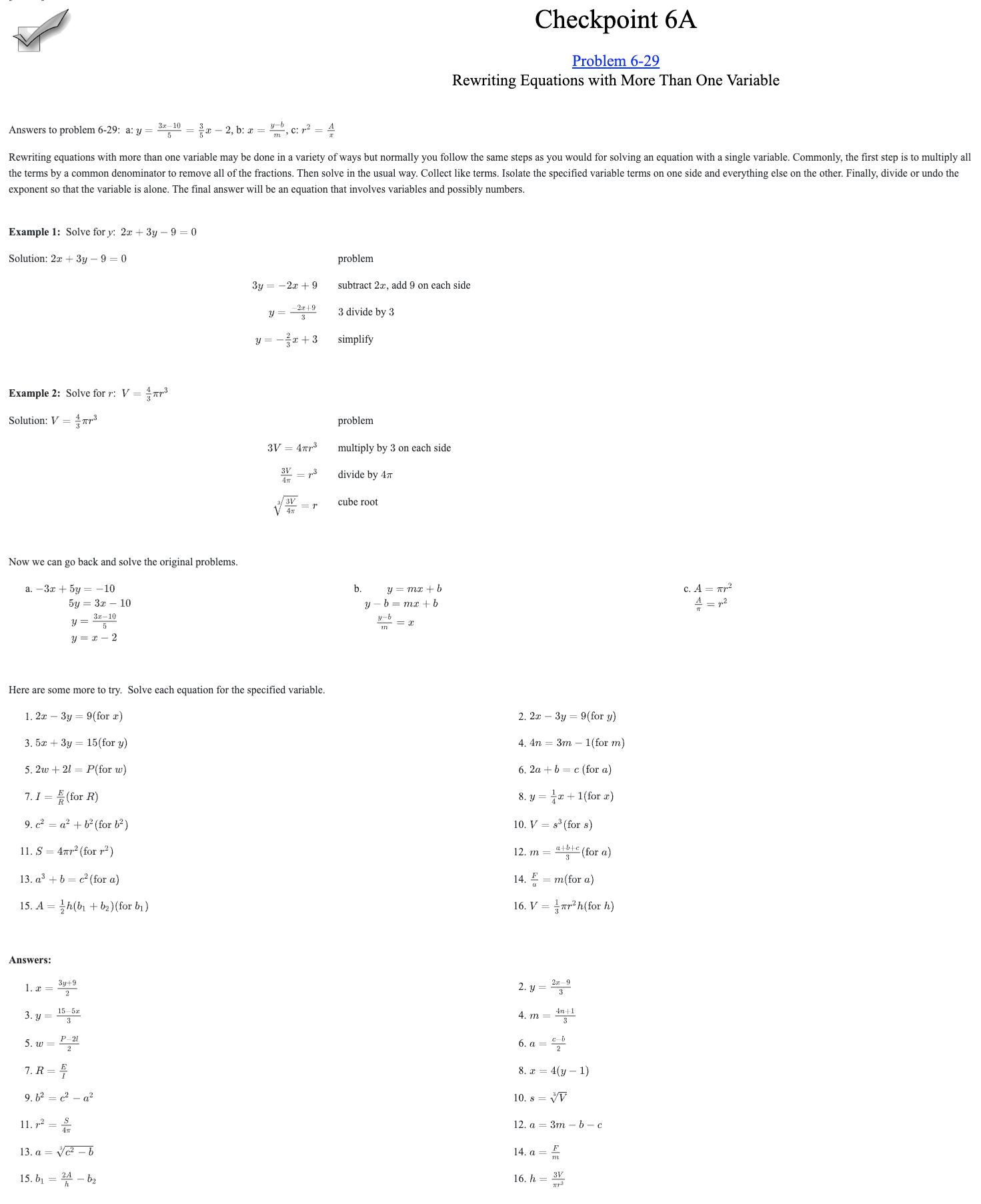
Checkpoints signal where students should have mastered a skill. Each one has the topic clearly labeled, a worked solution for self-assessment, detailed examples, and additional practice problems with answers.
Math Notes
Core ideas are synthesized in Math Notes boxes placed intentionally after a concept is introduced — giving students time to explore and build understanding before seeing a formal definition, algorithm, or summary.

Toolkits and Learning Logs
Consumable working documents that travel with your student throughout the course. Includes Learning Log entries, Math Notes, and images from the student edition — a personal reference tool they build themselves.
Encouraging Your Learner
Students who thrive in CPM aren't necessarily the ones who know the most math — they're the ones who show up, try, and ask for help. Here are the four habits that matter most.
01
Actively Participate
Contribute to team discussions, ask questions, and engage with problems — even when the answer isn't immediately obvious. The learning happens in the struggle.
02
Attempt All Assignments
Try every homework problem — not just the ones that look familiar. An honest attempt at a hard problem, even an incorrect one, is more valuable than skipping it.
03
Check and Correct Work
After getting answers back, actually review what went wrong and why. Mistakes that are understood — not just marked wrong — are one of the fastest paths to improvement.
04
Ask for Help
From their study team, from the teacher, from you. Asking for help is a sign of engagement, not weakness. Encourage your student to speak up — in class and at home.
Learning with Study Teams
These short videos explain the study team model — how it's structured, what effective teams look like, and how students interact. Watch them in order for the full picture.
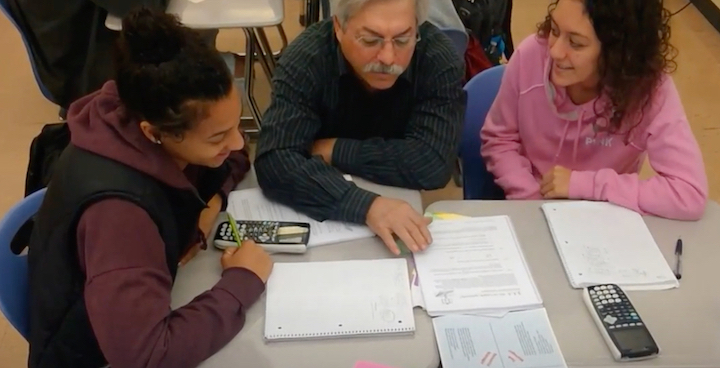
Introduction
An overview of the CPM program and the study team model — what it is, why it works, and what to expect throughout the year.
Guidelines
The norms and expectations for how study teams operate — including student roles, how teams get started, and what teachers are watching for.
Interactions
How students talk to each other about math — including what productive mathematical conversation sounds like and how teams navigate disagreement.
Team Support Guidebook
A detailed guide to how study teams work — including team roles, strategies for productive collaboration, and tips for supporting your student's participation.
Helping at Home
When working through a problem together
When your student has started but is unsure
When you and your student both feel stuck
All Year Long
35 weekly tips explaining how CPM works and how you can support your student at home. Click any week to read the full tip.
Fall — Weeks 1–12
Welcome to College Preparatory Mathematics, CPM. Your child will be involved in interesting and stimulating mathematics this school year. To help you understand what is happening in your child's math class, you will be receiving a Tip of the Week.
CPM believes that all students can be successful in mathematics as long as they are willing to work and ask for help when they need it. We encourage you to contact your child's teacher whenever you or your child have questions.
During class your child will often be working in a small group called a study team. Study teams are designed to encourage students to engage in mathematical conversations. These conversations allow students to develop new ways of thinking about mathematics, increase their abilities to communicate with others about math, and help strengthen their understanding of concepts and ideas as they explain their thinking to others. Each student in the study team has an assigned role with a clear set of expectations, which are listed in the student text and reinforced often by the teacher.
Because students are expected to work together to solve problems, the main role of the teacher is to pose the big problems and then to be a supporting guide during the solution process. Instead of just demonstrating a process and having students mimic it, your child's teacher will introduce the concept of the day and then circulate through the classroom, listening to team discussions, asking questions of teams and students, working with the teams as they solve the problems, and initiating a closure activity at the end of each lesson to ensure that the mathematics has been summarized.
The main objectives of the first chapter are to introduce the course to the students, allow them to apply previous learning in new ways, and review ideas from previous math courses. You will notice boxes titled "Math Notes." Math Notes boxes contain definitions, explanations, and/or examples. Your child's teacher will explain how these notes will be used in class.
The homework is in a section titled "Review and Preview." Each Review and Preview section consists of six to ten problems on a variety of topics and skills. Known as interleaving, this mixed spaced practice approach for homework leads to higher learning and better long-term retention.
CPM offers resources for parents and students within the student edition eBooks. In your student's eBook, select "Reference" from the bottom of the left-hand menu. Then select "Student Support" and select the appropriate tabs at the top. You might find it useful to take a look at the Parent Guide for the course — it contains explanations, examples, and practice problems for each topic covered.
The Homework Help feature is also available through the eBook. When your student is stuck on a homework problem, they can access hints and worked examples linked directly to the problem. Encourage your student to use these tools before coming to you — building independence is part of the CPM model.
Communication between parents and the teacher is important for student success. If you have not already had an open house or back-to-school night at your school, you might want to contact your student's teacher to open the channels of communication.
You can support the teacher and your student by letting the teacher know if your student is having difficulties at home completing homework, if they are frequently confused after class, or if they seem anxious or frustrated about math. The teacher can provide guidance and may be able to make adjustments to better support your student.
Most importantly, encourage your student to ask the teacher questions during class. The teacher is there to help and wants students to speak up when they are confused.
Practice and discussion are required to understand concepts in mathematics. When your child comes to you with a question about a homework problem, often you may be tempted to show them how to do the problem. While this may seem helpful, it can actually prevent them from developing their own problem-solving skills.
Instead, try asking questions: "What do you know about this problem?" "What have you already tried?" "Can you draw a picture?" "Does your answer make sense?" These questions encourage your student to think rather than watch.
If you work through a problem together, have your student explain each step. If neither of you can figure it out, that's okay — write down the question and bring it to class. Attempting the problem and identifying where you got stuck is valuable learning.
Mistakes are an important step in the process of learning. Don't let your student give up when they make one. Encourage your student to persevere, try another approach, and learn from what went wrong. Research shows that struggling productively with a difficult problem — and then figuring it out — leads to much deeper understanding than being shown the answer.
When your student gets a problem wrong, help them understand why rather than just correcting the answer. Ask: "What did you think was happening here?" "Where do you think it went off track?" This builds the metacognitive habits that make students stronger math learners over time.
By this time in the school year, your student may have taken a team test before taking an individual test. Team tests provide students an opportunity to check their depth of understanding through collaborative problem solving. They also help teachers identify general areas of concern that need to be addressed before the individual test.
Students who take notes, keep an organized notebook, and use their Toolkit perform better on tests. Encourage your student to review their notes and Toolkit as they prepare. If they struggled on any problems during team work, that's a signal to study those topics more carefully before testing individually.
There are several types of problems your child sees when doing classwork and homework. Classwork problems are designed to encourage students to work together with their teammates to solve engaging problems — sometimes requiring previous learning, manipulatives, or technology.
Homework problems ("Review and Preview") are different. They review material from earlier in the course AND preview upcoming topics — even ones that haven't been taught yet. Don't be alarmed if your student doesn't know how to do every homework problem. The preview problems are intentional: they plant seeds that grow when the concept is formally introduced in class.
Your student may have told you about working with new team members. In a student-centered classroom, teachers change team assignments periodically. This allows students to work with a variety of peers, learn different problem-solving approaches, and build broader social skills in a mathematical context.
If your student is anxious about a team change, remind them that every new team is an opportunity to grow — both mathematically and socially. The structure and roles stay the same; only the teammates change. Encourage them to approach new teammates with curiosity rather than anxiety.
There will be some topics your child understands quickly and some that take longer to master. Big ideas take time to learn. CPM's approach intentionally revisits concepts multiple times across weeks and chapters rather than teaching each topic once and moving on.
This is why your student may say "we're doing fractions again" or "we already did that." Repetition with spacing is one of the most research-supported methods for long-term learning. When a concept appears in homework long after it was introduced in class, it's reinforcing — not repeating — the learning.
To be successful in mathematics, students need to develop the ability to reason mathematically. This means thinking about what they already know, connecting it to new information, and constructing logical arguments for why their approach works — not just getting the right answer.
You can support this at home by asking your student to explain their reasoning, not just their answer. "How do you know that's right?" and "Can you show me another way to think about it?" are powerful questions that build mathematical thinking. Being able to explain is often more valuable than being able to calculate.
Ask your student to teach you some math that they feel they have mastered or are particularly proud of. Or ask them to show you some classwork from last week. This gives them an opportunity to feel proud of their work — and gives you an opportunity to be part of their learning.
When students explain their thinking to someone else, they solidify their own understanding, identify gaps they didn't know they had, and build confidence and mathematical vocabulary. Even if you already know the math, playing the role of "student" is one of the most powerful things you can do at home.
If you were to visit a CPM classroom, you would see the teacher doing more than standing at the front of the class telling students what they need to know. After introducing the day's objectives, students begin the lesson by connecting to what they already know. As students work in their teams, the teacher circulates throughout the classroom — listening to discussions, asking questions, and guiding without giving away answers.
This is intentional. The teacher's role in CPM is to facilitate learning, not deliver it. Students who develop the ability to construct knowledge through problem solving are better prepared for higher-level mathematics and for thinking through problems in life beyond school.
Winter — Weeks 13–24
This week is a good time to revisit the three videos available in the Study Teams section of this page. The first video is an overview of the CPM program. The second covers guidelines for effective study teams. The third shows student interactions in a CPM classroom.
If you watched them at the beginning of the year, watching them again now — with a few months of CPM experience under your belt — may give you a different perspective. You'll likely recognize things your student has described and understand the model more deeply now that it's not brand new.
In a CPM classroom, the student's role is different from what you may remember in your own math education. Rather than listening to the teacher lecture and copying procedures, CPM students are expected to actively engage — asking questions, discussing ideas with teammates, and constructing their own understanding.
This shift can feel uncomfortable at first, especially for students who are used to being told what to do. But students who embrace this role develop stronger mathematical thinking, better communication skills, and more confidence tackling unfamiliar problems — all of which serve them well beyond math class.
While working on the mathematics lesson, each student has a team-related job. The Resource Manager seeks input from each person and then calls the teacher over when the team has a question no one can answer. The Facilitator keeps the team on task and ensures everyone participates. The Recorder/Reporter organizes the team's work and shares it with the class. The Task Manager makes sure the team follows directions and uses time effectively.
Ask your student which role they currently hold and what they like or find challenging about it. These roles build real-world collaboration skills as much as mathematical ones.
In each chapter, one or more topics are identified as "Checkpoint" skills — skills students should have mastered or be close to mastering at that point in the course. Checkpoints are labeled in the student text and come with detailed examples and additional practice problems.
If your student struggles on a Checkpoint problem, this is a signal worth paying attention to. Encourage them to work through the Checkpoint examples and practice problems, and to ask their teacher for help before the end of the chapter. These skills tend to reappear in later chapters, so early mastery matters.
You might have read about growth mindset versus fixed mindset. In a math context, the core question is: can everyone learn math, or are some people just "math people"? Research strongly supports that mathematical ability is developed through effort, not born with — and that believing this makes a measurable difference in performance.
The most powerful thing you can do at home is model this belief. When your student says "I'm just not a math person," gently push back: "Math is something you get better at with practice, just like anything else." Praise effort and persistence rather than quick answers. This builds the mindset that makes long-term mathematical growth possible.
CPM teachers use many strategies to encourage students to work together successfully. Most strategies involve students talking about mathematics — explaining their thinking, questioning each other's reasoning, and building on each other's ideas. Some strategies involve physical movement, visual displays, or structured turn-taking.
Ask your student what strategies their class has been using lately. You might be surprised by what they describe — and it's a great conversation starter about what they're actually learning in math beyond just content.
Assessment in a CPM classroom is happening continuously. The teacher assesses student understanding as they circulate the classroom while teams work. This allows teachers to identify individual and group needs in real time and adjust instruction accordingly — not just after a test.
Formal assessments (tests and quizzes) do still occur. But in CPM, they're one part of a broader picture that includes participation, notebook quality, team contributions, and ongoing work. Encourage your student to stay engaged every day — the daily work matters as much as the test.
You might hear the phrase "differentiating instruction" — this refers to adjusting lessons to best meet students' varying needs. In CPM, differentiation happens through problem design: problems are built with "low floors and high ceilings," meaning all students can get started, and the problems extend naturally for students who move quickly.
Additionally, the study team structure itself differentiates: stronger students reinforce understanding by explaining to peers, while students who need more time get it within the team context. If your student needs additional support beyond what the classroom provides, contact their teacher to discuss options.
Research on the brain and student learning supports several of CPM's core design choices. Each brain is unique. Emotions run the show — students learn better when they feel safe and engaged. The brain rarely gets it right the first time; we make rough drafts of new learning. Humans are social and emotional learners. Information and memory are best retained when connected to meaning.
All of these findings explain why CPM emphasizes teams, productive struggle, spaced practice, and real-world context. The curriculum isn't just pedagogically fashionable — it's grounded in how brains actually work.
This week is a good time to check your student's classwork and homework. It should be neat, complete, and easy to understand. Ask them to explain one of the problems they recently did in class that they enjoyed. If the work is incomplete or difficult to read, you might want to check it more regularly or speak with their teacher.
A well-organized notebook is one of the strongest predictors of performance in CPM. If your student's notebook is disorganized or incomplete, help them develop a system — and make it a habit to review it together each week.
You may be hearing about the Common Core State Standards for Mathematics (CCSSM). These standards were written to create consistency in what students learn across the country, based on research into how students develop mathematical understanding. They focus on a clear set of mathematical skills and concepts, and encourage students to solve real-world problems — like those your student encounters in CPM.
The CCSSM aren't just a list of topics to cover. They also include eight Standards for Mathematical Practice — habits of mind that describe how mathematically proficient students think and work. We'll look at these practices over the coming weeks.
The Standards for Mathematical Practice describe eight behaviors that mathematically proficient students develop. They are: 1) Make sense of problems and persevere in solving them. 2) Reason abstractly and quantitatively. 3) Construct viable arguments and critique the reasoning of others. 4) Model with mathematics. 5) Use appropriate tools strategically. 6) Attend to precision. 7) Look for and make use of structure. 8) Look for and express regularity in repeated reasoning.
Over the next several weeks, we'll explore several of these practices in more detail and show how CPM builds them into daily classroom work.
Spring — Weeks 25–35
The first Standard for Mathematical Practice is: Make sense of problems and persevere in solving them. Mathematically proficient students start by explaining to themselves what a problem is asking and what an answer might look like. They consider analogous problems, try special cases, and monitor their own progress — adjusting their approach if needed.
You can support this practice at home by resisting the urge to jump in with answers. When your student is stuck, ask: "What do you think this problem is really asking?" Give them time to sit with the difficulty. Perseverance in math is a muscle — it gets stronger with practice.
The third Standard for Mathematical Practice is: Construct viable arguments and critique the reasoning of others. Mathematically proficient students can explain and justify their mathematical thinking — and can evaluate the arguments of others, identifying what's correct and what might be flawed.
In CPM, this happens daily in team discussions. Students are expected to explain their reasoning, not just their answers. You can reinforce this at home by asking your student to convince you their answer is correct — not just to show you the work, but to make a case for why it makes sense.
The fourth Standard for Mathematical Practice is: Model with mathematics. Mathematically proficient students can apply the math they know to solve problems in everyday life — writing equations, creating diagrams, making tables, and interpreting mathematical results in context.
CPM is built around this practice. Nearly every problem in the curriculum is set in a real-world context. When your student asks "when will I ever use this?" — point to this standard. The goal isn't just to solve abstract equations; it's to develop tools for thinking about the world.
The fifth Standard for Mathematical Practice is: Use appropriate tools strategically. This means knowing when to use a calculator, when to use paper and pencil, when to draw a diagram, when to use manipulatives, and when a mental estimate is enough.
In CPM, students are regularly given choices about tools — and are expected to make good decisions about which tool fits the problem. This is a real-world skill. Ask your student what tools they used in class this week and why they chose them.
The sixth Standard for Mathematical Practice is: Attend to precision. Mathematically proficient students communicate clearly and precisely — using correct mathematical vocabulary, specifying units of measure, labeling diagrams accurately, and checking that their answers are reasonable.
Precision in math isn't just about getting the right number — it's about communicating clearly enough that someone else can follow your reasoning. Encourage your student to write their work neatly and completely, and to check whether their answer actually makes sense in the context of the problem.
The seventh Standard for Mathematical Practice is: Look for and make use of structure. Mathematically proficient students look for patterns, recognize repeated forms, and use the structure of mathematical objects to simplify problems.
When your student says "this looks just like a problem we did before," they're using this practice. Encourage that kind of pattern-recognition thinking. Asking "have you seen something like this before?" or "does this remind you of anything?" helps students develop the habit of looking for structure.
The eighth Standard for Mathematical Practice is: Look for and express regularity in repeated reasoning. Mathematically proficient students notice when calculations are repeated and look for general methods and shortcuts — while also checking whether intermediate results are reasonable.
Ask your student if they've developed any shortcuts for problems they do frequently. If they have, ask them to explain why the shortcut works. Understanding why a shortcut is valid is a deeper form of knowledge than just knowing the trick.
Student presentations are an ongoing part of the CPM mathematics program. Students are expected to participate in both formal and informal presentations. Informal presentations can be done by individuals or teams — usually covering a problem or idea explored that day. More formal presentations are typically connected to an investigation or project.
Presenting mathematical thinking is one of the highest-level skills students can develop. It requires understanding, clarity, and confidence. If your student is nervous about presenting, remind them that the goal is to share thinking — not to be perfect — and that their class is a safe environment to do that.
As the year winds down, this is a good time to reflect on how far your student has come. Ask them: What's the most interesting thing you learned in math this year? What was the hardest problem you solved? What are you most proud of?
Recognizing growth — not just grades — is one of the most powerful things you can do as a parent. Students who can identify their own progress become more motivated and resilient learners. Celebrate the effort, not just the outcome.
As the school year ends, it's worth thinking about what comes next. Talk with your student about what math course they'll be taking next year and what skills they'll want to carry forward. Encourage them to keep their notebook and review it over the summer — even briefly.
Research shows that students who engage with math for even a few minutes a week over the summer retain significantly more than those who disengage entirely. A few review problems, a math game, or even a mathematical conversation can make a real difference heading into next year.
Thank you for your support throughout the school year. Your involvement — even in small ways — makes a meaningful difference to your student's success in mathematics. Asking about their day, reviewing their notebook, watching a video, or simply encouraging them to keep going when it's hard — all of it matters.
CPM is built on the belief that all students can be successful in mathematics. Your student has spent a year building problem-solving skills, mathematical habits of mind, and collaborative abilities that will serve them well beyond this class. We hope it's been a rewarding year for your family.
Still Have Questions?
The best person to answer specific questions about your student's progress is their teacher. You can also explore Student Learning Resources for additional support tools.
2.3.4
Defining Concavity
4.4.1
Characteristics of Polynomial Functions
5.2.6
Semi-Log Plots
5 Closure
Closure How Can I Apply It? Activity 3
9.3.1
Transition States
9.3.2
Future and Past States
10.3.1
The Parametrization of Functions, Conics, and Their Inverses
10.3.2
Vector-Valued Functions
11.1.5
Rate of Change of Polar Functions

This professional learning is designed for teachers as they begin their implementation of CPM. This series contains multiple components and is grounded in multiple active experiences delivered over the first year. This learning experience will encourage teachers to adjust their instructional practices, expand their content knowledge, and challenge their beliefs about teaching and learning. Teachers and leaders will gain first-hand experience with CPM with emphasis on what they will be teaching. Throughout this series educators will experience the mathematics, consider instructional practices, and learn about the classroom environment necessary for a successful implementation of CPM curriculum resources.
Page 2 of the Professional Learning Progression (PDF) describes all of the components of this learning event and the additional support available. Teachers new to a course, but have previously attended Foundations for Implementation, can choose to engage in the course Content Modules in the Professional Learning Portal rather than attending the entire series of learning events again.
The Building on Instructional Practice Series consists of three different events – Building on Discourse, Building on Assessment, Building on Equity – that are designed for teachers with a minimum of one year of experience teaching with CPM instructional materials and who have completed the Foundations for Implementation Series.
In Building on Equity, participants will learn how to include equitable practices in their classroom and support traditionally underserved students in becoming leaders of their own learning. Essential questions include: How do I shift dependent learners into independent learners? How does my own math identity and cultural background impact my classroom? The focus of day one is equitable classroom culture. Participants will reflect on how their math identity and mindsets impact student learning. They will begin working on a plan for Chapter 1 that creates an equitable classroom culture. The focus of day two and three is implementing equitable tasks. Participants will develop their use of the 5 Practices for Orchestrating Meaningful Mathematical Discussions and curate strategies for supporting all students in becoming leaders of their own learning. Participants will use an equity lens to reflect on and revise their Chapter 1 lesson plans.
In Building on Assessment, participants will apply assessment research and develop methods to provide feedback to students and inform equitable assessment decisions. On day one, participants will align assessment practices with learning progressions and the principle of mastery over time as well as write assessment items. During day two, participants will develop rubrics, explore alternate types of assessment, and plan for implementation that supports student ownership. On the third day, participants will develop strategies to monitor progress and provide evidence of proficiency with identified mathematics content and practices. Participants will develop assessment action plans that will encourage continued collaboration within their learning community.
In Building on Discourse, participants will improve their ability to facilitate meaningful mathematical discourse. This learning experience will encourage participants to adjust their instructional practices in the areas of sharing math authority, developing independent learners, and the creation of equitable classroom environments. Participants will plan for student learning by using teaching practices such as posing purposeful questioning, supporting productive struggle, and facilitating meaningful mathematical discourse. In doing so, participants learn to support students collaboratively engaged with rich tasks with all elements of the Effective Mathematics Teaching Practices incorporated through intentional and reflective planning.