
Inspirations & Ideas — 8th Grade Support

Fraction Feud
A Card Game for Fraction Reasoning

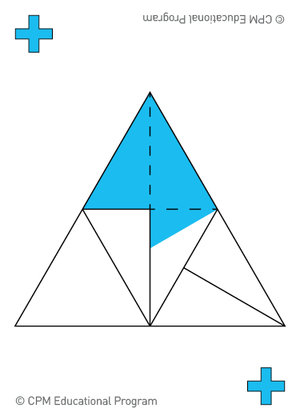
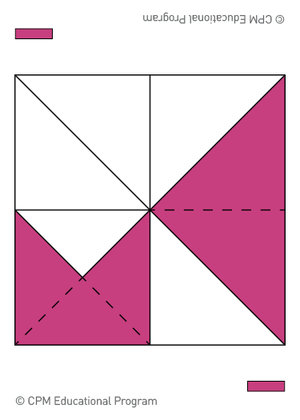
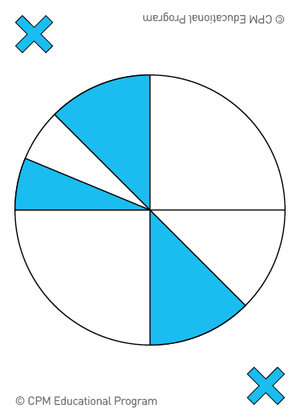
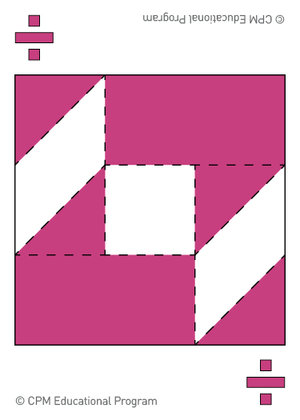
Fraction Feud was developed to engage students with fractions in ways they may not have experienced before. The fraction of area shaded on each card is that card's value — students compare, compute, and compete their way to fluency.

52 Cards per deck
13 Different fractions
4 Operations (+, -, ×, ÷)
Fraction Feud card deck
Why It Works

Great for Reasoning, Not Just Rules

Fraction Feud cards are ripe with opportunities to reason about unit fractions, equivalent fractions, magnitude, and partitioning — everything students need to develop deep fraction sense, instead of relying on procedures.

Fraction Feud card example
"

The kids absolutely loved Fraction Feud War, and they were really sad the class ended.

CPM Teacher

"

Students have such a negative view of fractions. Trying to use them in a game is a great way to focus their thinking.

CPM Teacher

"

It was good practice for them to find what fractions the cards represent and then compare them.

CPM Teacher

How to Play

Five Ways to Play Fraction Feud

All games use the same 52-card deck. Mix and match throughout the year to keep fraction reasoning fresh and engaging.

Fraction Feud War

2 players

Deal all cards evenly. Each player flips their top card — the player with the greater fraction wins both cards. If the cards are equivalent, it's war: each player places one card face down, then one face up. The greatest fraction wins all six cards. The player who collects the full deck wins.

Slap <⅜

2+ players

Players take turns placing cards face up in the center pile. When the top card shows a fraction less than ⅜, the first player to slap it and correctly name the fraction wins the pile. Slapping a card greater than or equal to ⅜, or misidentifying the fraction, means you give the pile to a correct challenger.

Go Fish Fractions

2–5 players

Deal 7 cards each (2–3 players) or 5 cards each (4–5 players). Players ask for a specific fraction to make equivalent pairs. If the asked player doesn't have it, "Go Fish" in the center pile. Equivalent pairs are removed from play. The player with the most pairs wins.

Fraction Concentration

2–3 players

Lay all cards face down in rows. Players take turns flipping two cards looking for a matching pair (same image, same color). When a match is found, the player must correctly name the fraction to claim the pair — otherwise another player can steal it. Most pairs wins. Half the deck works for two players.

Last Fraction Standing

4+ players

Deal all cards to the class. Players find a partner and play one round of Fraction Feud War — the loser surrenders all their cards and sits down. Winners shuffle and find a new partner. Play continues until one player holds the entire deck. Great as a full-class activity.

Practice Activities

Beyond the Games

Three quick activities that use the Fraction Feud cards for structured practice — great for warm-ups, centers, or early finishers.

WODB

Turn four different cards face up. Choose which card does not belong with the others and justify why. Multiple right answers are possible — the reasoning is the point.

Operations

Turn two cards face up. Determine the value of each card, then perform the operations shown on each card with those fractions. A quick, flexible computation activity for any skill level.

Fraction Sort

Separate one operation (+, -, ×, or ÷) from the deck. Arrange all 13 cards for that operation in ascending order based on their values. A great visual exercise for understanding how operations affect fraction size.

Share Your Ideas

Found a New Way to Use Fraction Feud?

We'd love to hear it. Submit your ideas to the intervention team for consideration — or get in touch to learn more about the Inspirations & Ideas course.

Statistics

JAVA

Calculus
Third Edition

Precalculus
Third Edition

Precalculus
Supplement

2.3.4

Defining Concavity

4.4.1

Characteristics of Polynomial Functions

5.2.6

Semi-Log Plots

5 Closure

Closure How Can I Apply It? Activity 3

9.3.1

Transition States

9.3.2

Future and Past States

10.3.1

The Parametrization of Functions, Conics, and Their Inverses

10.3.2

Vector-Valued Functions

11.1.5

Rate of Change of Polar Functions

Matemática
Integrada I

Matemática
Integrada II

Matemática
Integrada III

Integrated I

Integrated II

Integrated III

Core Connections en español, Álgebra

Core Connections en español, Geometría

Core Connections en español, Álgebra 2

Core Connections
Algebra

Core Connections Geometry

Core Connections
Algebra 2

Core Connections 1

Core Connections 2

Core Connections 3

Core Connections en español,
Curso 1
Core Connections en español,
Curso 2
Core Connections en español,
Curso 3

Inspiring Connections
Course 1

Inspiring Connections
Course 2

Inspiring Connections
Course 3

Sample Checkpoint

You are now leaving cpm.org.

Did you want to leave cpm.org?

I want to leave cpmstg.wpengine.com.

No, I want to stay on cpmstg.wpengine.com

Algebra Tiles Blue Icon

Algebra Tiles Session

  • Used throughout CPM middle and high school courses
  • Concrete, geometric representation of algebraic concepts.
  • Two-hour virtual session,
  •  Learn how students build their conceptual understanding of simplifying algebraic expressions
  • Solving equations using these tools.  
  • Determining perimeter,
  • Combining like terms,
  • Comparing expressions,
  • Solving equations
  • Use an area model to multiply polynomials,
  • Factor quadratics and other polynomials, and
  • Complete the square.
  • Support the transition from a concrete (manipulative) representation to an abstract model of mathematics..

Foundations for Implementation

This professional learning is designed for teachers as they begin their implementation of CPM. This series contains multiple components and is grounded in multiple active experiences delivered over the first year. This learning experience will encourage teachers to adjust their instructional practices, expand their content knowledge, and challenge their beliefs about teaching and learning. Teachers and leaders will gain first-hand experience with CPM with emphasis on what they will be teaching. Throughout this series educators will experience the mathematics, consider instructional practices, and learn about the classroom environment necessary for a successful implementation of CPM curriculum resources.

Page 2 of the Professional Learning Progression (PDF) describes all of the components of this learning event and the additional support available. Teachers new to a course, but have previously attended Foundations for Implementation, can choose to engage in the course Content Modules in the Professional Learning Portal rather than attending the entire series of learning events again.

Building on Instructional Practice Series

The Building on Instructional Practice Series consists of three different events – Building on Discourse, Building on Assessment, Building on Equity – that are designed for teachers with a minimum of one year of experience teaching with CPM instructional materials and who have completed the Foundations for Implementation Series.

Building on Equity

In Building on Equity, participants will learn how to include equitable practices in their classroom and support traditionally underserved students in becoming leaders of their own learning. Essential questions include: How do I shift dependent learners into independent learners? How does my own math identity and cultural background impact my classroom? The focus of day one is equitable classroom culture. Participants will reflect on how their math identity and mindsets impact student learning. They will begin working on a plan for Chapter 1 that creates an equitable classroom culture. The focus of day two and three is implementing equitable tasks. Participants will develop their use of the 5 Practices for Orchestrating Meaningful Mathematical Discussions and curate strategies for supporting all students in becoming leaders of their own learning. Participants will use an equity lens to reflect on and revise their Chapter 1 lesson plans.

Building on Assessment

In Building on Assessment, participants will apply assessment research and develop methods to provide feedback to students and inform equitable assessment decisions. On day one, participants will align assessment practices with learning progressions and the principle of mastery over time as well as write assessment items. During day two, participants will develop rubrics, explore alternate types of assessment, and plan for implementation that supports student ownership. On the third day, participants will develop strategies to monitor progress and provide evidence of proficiency with identified mathematics content and practices. Participants will develop assessment action plans that will encourage continued collaboration within their learning community.

Building on Discourse

In Building on Discourse, participants will improve their ability to facilitate meaningful mathematical discourse. This learning experience will encourage participants to adjust their instructional practices in the areas of sharing math authority, developing independent learners, and the creation of equitable classroom environments. Participants will plan for student learning by using teaching practices such as posing purposeful questioning, supporting productive struggle, and facilitating meaningful mathematical discourse. In doing so, participants learn to support students collaboratively engaged with rich tasks with all elements of the Effective Mathematics Teaching Practices incorporated through intentional and reflective planning.