For Families
Supporting Your Student in CPM Math
CPM may look different from the math you remember, and that's intentional. This page explains how CPM works, why it works, and how you can support your student at home without needing to know every answer yourself.
Start Here
What do you need today?
Most families arrive with one of these in mind. Pick the closest match, or keep scrolling to learn how a CPM classroom works.
Parent Guides Core Connections 2nd Edition
Worked examples and practice for every chapter, in English and Spanish. Download the whole book or one chapter.
Open the guides →Guided Skill Supports Core Connections 3rd Edition
Organized by chapter. Each topic starts with an overview of the concept or skill, then detailed examples with complete solutions and additional problems, with answers, to try.
Find your course →A Letter Home
A short letter for every chapter explaining what the class is learning and the words students will use.
Read this chapter →Support for Every Learner
IEPs and 504 plans, multilingual learners, students who are struggling, and students who need more challenge.
See what helps →Tools for Students
eTools, glossaries in English and Spanish, and ways to get unstuck. Built for the student rather than the adult.
Open student tools →Team Support Guidebook
What study teams are, why the class is arranged that way, and how to talk with your student about it.
Read the guidebook →Support at Home
Get math tips in your inbox
A short email for anyone helping a student at home, whether you are a parent, caregiver, grandparent, or tutor. Practical ways to support their math, plus new resources as we add them. No classroom jargon.
How CPM Works
Study Teams
Students work in collaborative study teams of 2–4 every day. Teams are designed to encourage mathematical conversation, students explain their thinking, question each other, and build understanding together. Each student has an assigned role.
This is why your student might say "I learned it from my group" rather than "the teacher showed us."
Problem-Based Learning
The teacher poses a big problem and then circulates, listening, asking questions, and guiding rather than lecturing. Students construct mathematical understanding by working through problems collaboratively.
This is why homework can feel hard, students are expected to try, not just reproduce a formula.
Mixed, Spaced Practice
Independent practice ("Review and Preview" in Core Connections and "Reflection & Practice" in Inspiring Connections) contains problems from multiple topics, not just tonight's lesson. This interleaving is intentional: revisiting past material repeatedly leads to better long-term retention than blocked practice.
This is why homework doesn't always match the day's lesson, and why it works.
Course Overviews
See Your Student’s Course
Each overview walks through what a course covers, how the materials are organized, and what students work on across the year. Find the course a student is taking and watch the one that matches.
More Resources Inside Every Course
CPM courses include additional learning tools embedded directly in the student materials, each designed to support a different kind of understanding. Some of these go by different names depending on which course and edition your student is using, so both names are listed below.
Checkpoints
Checkpoints signal where students should be proficient with a skill. Each one has the topic clearly labeled, a worked solution for self-assessment, detailed examples, and additional practice problems with answers.
Math Notes and Methods & Meanings
Core ideas are synthesized in boxes placed intentionally after a concept is introduced, giving students time to explore and build understanding before seeing a formal definition, algorithm, or summary. These are called Math Notes in 2nd Edition, and Methods and Meanings in 3rd Edition and Inspiring Connections.
Toolkits and Journals
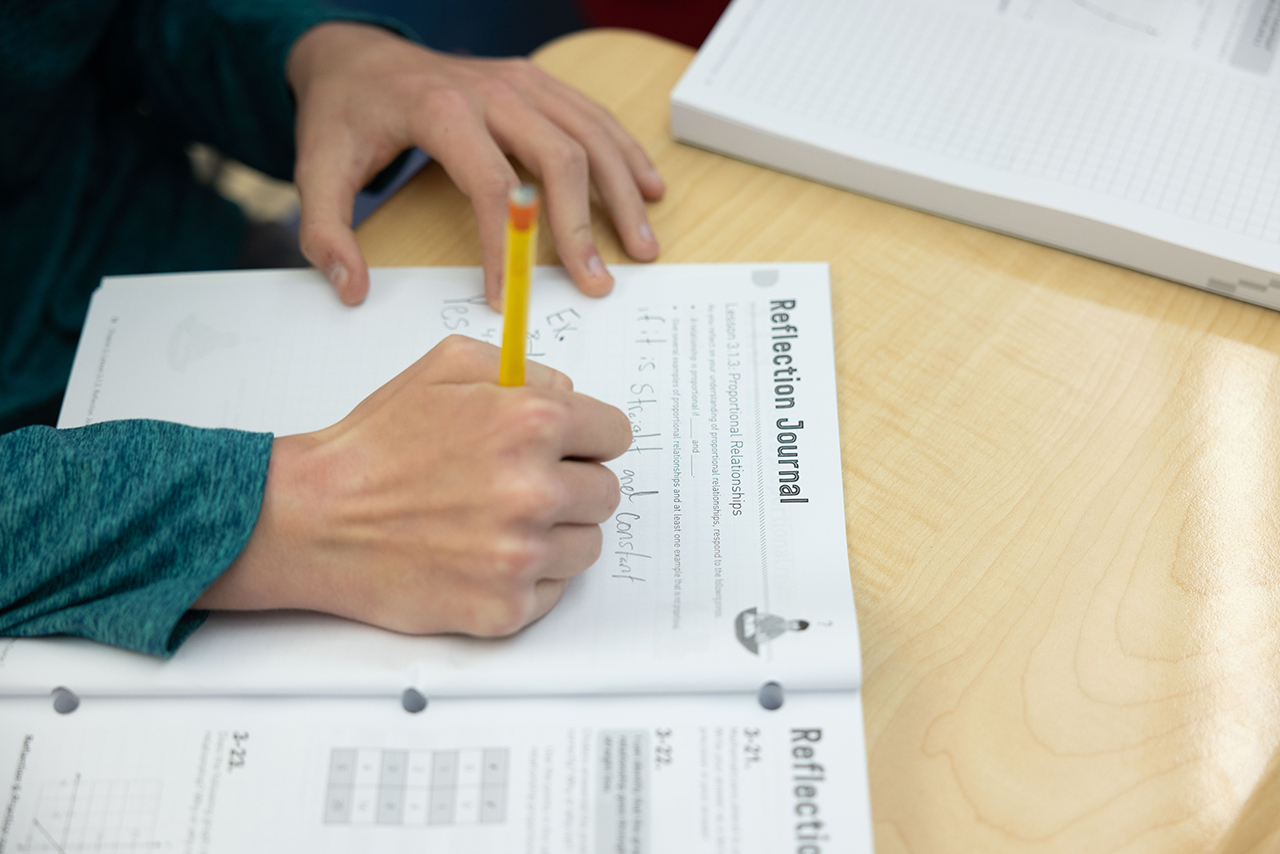
Consumable working documents that travel with your student throughout the course, holding their own entries, key ideas, and images from the student edition. This personal reference is called a Toolkit with Learning Logs in 2nd Edition, and a Reflection and Goal Journal in 3rd Edition and Inspiring Connections.
What Successful Students Do
Students who thrive in CPM aren't necessarily the ones who know the most math, they're the ones who show up, try, and ask for help. Here are the four habits that matter most.
01
Actively Participate
Contribute to team discussions, ask questions, and engage with problems, even when the answer isn't immediately obvious. The learning happens in the struggle.
02
Attempt All Assignments
Try every homework problem, not just the ones that look familiar. An honest attempt at a hard problem, even an incorrect one, is more valuable than skipping it.
03
Check and Correct Work
After getting answers back, actually review what went wrong and why. Mistakes that are understood, not just marked wrong, are one of the fastest paths to improvement.
04
Ask for Help
From their study team, from the teacher, from you. Asking for help is a sign of engagement, not weakness. Encourage your student to speak up, in class and at home.
See How Study Teams Work
Three short videos, best watched in order: how a CPM classroom works, the expectations teams follow, and what student conversation sounds like.
Introduction
An overview of the CPM program and the study team model, what it is, why it works, and what to expect throughout the year.
Guidelines
The norms and expectations for how study teams operate, including student roles, how teams get started, and what teachers are watching for.
Interactions
How students talk to each other about math, including what productive mathematical conversation sounds like and how teams navigate disagreement.
Team Support Guidebook
A guide for families on how study teams work, what your child’s teacher is doing while teams work, and what to expect as collaboration takes hold across the year.
All Year Long
Family Tips of the Week
35 weekly tips for families, caregivers, and tutors, explaining how CPM works and how you can support your student at home. Click any week to read the full tip.
Print every tip in this season as one packet.
Your student will be engaged in interesting and stimulating mathematics this school year. To help you stay involved with what is happening in your student’s math class, we have created these weekly tips for families, caregivers, tutors, and more.
CPM’s vision is a world where mathematics is viewed as intriguing and useful, and appreciated by all, where powerful mathematical thinking is an essential, universal, and desirable asset. CPM’s mission is to empower mathematics students and teachers through exemplary curriculum, professional development, and leadership.
CPM believes that all students can be successful in mathematics. Reach out to your student’s teacher whenever you or your student have questions. Communication between families and teachers is one of the most important ingredients for student success.
During class, your student will work in a small collaborative study team of two to four students. These teams are at the heart of CPM’s approach: learning is social, and students understand mathematics more deeply when they work together to reason through problems, explain their thinking, and hear each other’s ideas.
The role of the teacher in a CPM classroom is to pose questions, problems, and tasks while supporting students in working collaboratively in the problem-solving process. Instead of just demonstrating a process and having students mimic it, your student’s teacher will introduce the concept of the day and then circulate through the class as students investigate, listening to team discussions, asking questions, and intentionally selecting teaching and learning strategies that support students’ learning and collaboration. The teacher also facilitates a closure activity at the end of each lesson so that students consolidate their learning.
Each lesson follows a consistent structure: a Launch to get students engaged, an Explore phase where students work collaboratively, and a Closure to consolidate the day’s learning. The lesson is followed by independent practice (Reflection & Practice in Inspiring Connections or Review & Preview in Core Connections), a short, intentionally designed set of problems that replaces traditional homework. Each section has about 5 to 6 problems on a variety of topics and skills. Known as interleaving, this mixed, spaced practice approach leads to deeper learning and better long-term retention.
This week, introduce yourself to your student’s teacher if you haven’t already. Ask your student, "What did you work on in math class today and who did you work with?"
CPM offers a wide range of resources for families and students. Here are a few of the most useful places to start. Ask your student to show you these in their digital platform or eBook:
- Skill Builders (Inspiring Connections): Worked examples and practice problems organized from Mild to Medium to Spicy, so students can build fluency at their own level.
- Tools and Topics letters (Inspiring Connections): A spotlight on a teaching or learning practice, a look at how the current chapter fits the bigger picture, suggested help materials, and a "Try This at Home!" section.
- Guided Skill Supports (Core Connections 3rd Edition): Organized by chapter and topic, with overviews, examples with complete solutions, and practice problems with answers.
- Checkpoint Materials (Core Connections 3rd Edition): Problem sets with review, worked examples, and additional practice with answers.
- eTools (all series): Virtual algebra tiles, graphing tools, and other interactive tools built into the platform, accessible from the Toolbox dropdown in any lesson.
Students may also have printed materials. Inspiring Connections students have a Mathematician’s Notebook for recording rough-draft thinking, key concepts, reflections, and learning targets. Core Connections students may have a Toolkit that includes daily independent practice, journals, and vocabulary.
There’s even more at cpm.org. Visit cpm.org/help-your-student for the student experience, family resources, and great questions to support a student when they’re getting started, in progress, or stuck. Visit cpm.org/research to explore the Three Pillars (Collaborative Learning, Problem-Based Learning, Mixed Spaced Practice) and the 2024 research that supports them.
This week, sit down with your student and find one resource in their digital platform together, such as Skill Builders, Guided Skill Supports, or eTools.
If you haven’t yet connected with your student’s teacher, now is a great time to reach out. You don’t need to be a math expert to make a real difference. Here are some of the most impactful things any caring adult can do:
- Talk about why mathematics matters. Help your student connect math to their own life, goals, and community. This makes the learning feel meaningful.
- Affirm that math ability grows with effort. CPM’s entire design is built on the belief that all students can develop as mathematical thinkers. Avoid saying things like, "I was never good at math, either," as this can inadvertently reinforce the idea that math ability is fixed.
- Encourage consistent habits: attending class, completing independent practice, asking questions in teams, and using available resources.
- Ask your student to explain their thinking. You don’t need to understand the mathematics. Listening actively and asking "why?" is one of the most powerful ways to support learning.
- Review the notebook. Take time to look at your student’s Mathematician’s Notebook (Inspiring Connections) or Toolkit (Core Connections). These are windows into what your student is thinking and learning.
CPM’s Eight Competencies for Culturally Responsive Pedagogy include Competency 7: Collaborate with families and the local community. CPM genuinely values your presence and interest in your student’s mathematical education, as does your student’s teacher.
This week, pick one item from the list above and try it. Even a five minute conversation on the way home can be a meaningful act of support. You could simply ask, "What did you work on in math today?" You don’t have to help with the math to make a difference.
Practice and discussion are essential for mathematical understanding. When a student comes to you with a question about their independent practice (what some may call homework), try not to guide them to the correct answer or method right away. Instead, ask them to read the problem aloud and explain what it’s asking. Have them talk through their thinking as they work. In Core Connections this practice is called "Review & Preview"; in Inspiring Connections it is called "Reflection & Practice."
Here are questions to try for different situations:
- If they’re just getting started: What have you tried? What do you know about this problem right now? What didn’t work, and why?
- If they’ve made some progress: What do you think comes next? What’s still left to figure out? Is that the only possible answer?
- If they’re completely stuck: Let’s look at the Mathematician’s Notebook or Reflection Journal. What lesson did you learn this in? Can you find a similar problem you’ve already worked on? What did your team discuss?
Independent Practice is designed to include problems like the following: a number sense warm-up that can often be done mentally; one or two problems connected to the day’s lesson; two to four problems that revisit earlier content; a problem that previews future work; and a reflection prompt where students reflect on the day’s learning, their teamwork, or set a personal goal.
Remind your student to use built-in resources: Methods & Meanings boxes, Skill Builders, Checkpoint materials, the index, and the glossary. These are designed to support independent learning, not just to be assigned by teachers.
CPM advocates for a perspective that welcomes productive struggle, understanding it as a natural process through which students learn and develop a positive math identity and a sense of accomplishment. Mistakes are not a sign of failure; they are a necessary part of the learning process.
When your student makes a mistake or gets frustrated with a problem, encourage them to persevere, try a different approach, or talk it through. Giving up too quickly short-circuits the productive struggle that builds real understanding.
The curriculum also uses a practice called Rough Draft Talk, which invites students to share emerging, unfinished ideas without pressure to be right. This lowers the stakes and increases participation.
Speed is not the goal. CPM’s curriculum intentionally includes fewer problems than a traditional textbook, so students can think deeply about the mathematics and persevere. Encourage your student to slow down and ask, "does this answer make sense?"
The next time your student says "I don’t get it" or wants to give up on a problem, try asking, "What have you tried so far?" Then wait. Let them think. The pause creates a reflective space where students can process information and thoughtfully compose their response, making it an integral part of learning.
CPM’s curriculum is grounded in three research-informed pillars, validated by CPM’s 2024 Research Base.
- Collaborative Learning: Students learn mathematics more deeply when they work with peers to reason through problems, explain thinking, and listen to diverse approaches. Collaboration is not just a seating arrangement; CPM’s Study Team and Teaching Strategies (STTSs) are specifically designed to make collaborative work genuinely productive.
- Problem-Based Learning: Students learn more effectively and durably when they encounter mathematics through problems to be solved, ideally from real-world contexts, rather than by first being shown a procedure and then applying it. Problems in CPM are designed to be non-routine, team-worthy, and engaging.
- Mixed, Spaced Practice: Students retain mathematics more permanently when they engage and re-engage with ideas over months, not just in a single unit. CPM’s Reflection & Practice and Review & Preview are strategically designed around the learning science principles of spacing and interleaving.
By this point in the year, your student may have participated in a Team Challenge before an Individual Test. Team Challenges are collaborative assessments that deepen understanding and help the teacher identify areas to address before individual assessment. Students who take notes during Team Challenges and who correct and revise their work often see significant improvement on Individual Tests.
If your student has participated in a Team Challenge recently, ask them, "What did your team figure out together that you couldn’t have done alone?" Their answer will tell you a lot about how CPM’s collaborative approach is working for them.
CPM problems are intentionally designed with a specific learning purpose. Understanding the types of tasks your student encounters can help you support them at home.
- Launch problems open each lesson to prime students’ brains for learning and ensure equitable access to the mathematics. Common Launches include Math Chats, Notice and Wonder routines, and Data Chats. Most Launches take about five minutes.
- Explore problems are the heart of each lesson. They are collaborative, thought-provoking investigations completed in teams. Some use manipulatives like algebra tiles. All are designed to require reasoning, not just following procedures.
- Closure activities end each lesson. They take many forms: exit tickets, journal entries, class discussions, or Exhibit Visits where teams view each other’s work. Closure helps students consolidate the day’s learning and gives the teacher a real-time view of student understanding.
- Reflection & Practice (Inspiring Connections) and Review & Preview (Core Connections) are the independent practice sections. It is intentionally short and mixes review of today’s lesson with spaced practice of earlier content.
If your student is struggling with independent practice, they can look at their classwork, the related lesson, or the Methods & Meanings boxes with support for that topic. This week, ask your student to talk you through one problem from their independent practice and explain not only the answer, but which part of the lesson it came from and what strategy they used. Notice whether they can make the connection.
Your student may have mentioned working with different teammates recently. This is intentional. In CPM classrooms, students work in new teams regularly. Teams often change daily and are assigned in visibly random ways, which is a research-informed practice from Peter Liljedahl’s Building Thinking Classrooms (2020).
Visibly random grouping serves several important purposes:
- It disrupts status hierarchies. When teams are random, students cannot sort themselves by perceived ability, and everyone is positioned as a capable contributor.
- It broadens exposure. Students encounter diverse mathematical thinking, communication styles, and approaches to problems when they do not work with the same other students every time.
- It builds community. Over time, students develop the ability to collaborate with anyone, which is a skill that mirrors how collaborative work happens outside of school.
Research shows that students who work in collaborative problem-solving situations develop higher achievement, stronger retention, greater intrinsic motivation, and more positive attitudes toward mathematics and school. For more, see cpm.org/research-base.
Ask your student who they worked with in their team this week. Did they work with anyone they’ve worked with before? What did they notice about working with someone new or different? What did that person contribute that surprised them?
Some concepts your student might grasp quickly; others might take longer. This is expected and designed for in the curriculum. CPM’s curriculum is built around the principle that big ideas take time to develop, and students are not expected to be fully proficient with a concept the first time it appears.
Major Conceptual Ideas, the big mathematical themes of each course, are threaded throughout the year so that students engage and re-engage with the same ideas in new contexts over many weeks. This is not repetition for its own sake; it reflects how mathematical understanding actually grows.
Learning Targets and Language Objectives ("I Can" statements) appear at the beginning of each lesson, and students can use these to self-assess their progress throughout the chapter, not just at the end.
If your student needs extra practice, the resources vary by series:
- Inspiring Connections: Skill Builders are organized by topic with info about where the topic is introduced in each chapter. Students can work at the Mild, Medium, or Spicy level and check their own answers.
- Core Connections: Checkpoint problems and Guided Skill Supports support students with concepts and provide extra practice.
This week, look at the Learning Targets and Language Objectives at the beginning of each lesson together. Ask your student to reflect on their proficiency: still working on it, getting there, or got it.
Mathematical reasoning grows when students connect what they already know to new ideas. CPM’s mathematical storyline is intentionally designed so that today’s lesson builds on last week’s and revisits ideas from earlier in the year. This often surprises students at first, but it is one of the most powerful features of how CPM develops lasting understanding.
Your student can strengthen their learning by:
- Contributing actively in team and class discussions, explaining their thinking, not just giving answers.
- Explaining what they’ve learned to someone else. Teaching is one of the most effective ways to solidify understanding.
- Completing their independent practice problems and using them for reflective self-assessment.
- Using Learning Targets and Language Objectives to track their own progress and identify areas to revisit.
- Asking for help early on, from teammates, the teacher, or a trusted adult, before small gaps become bigger ones.
- Updating and revising their journal entries and notes. These are their personalized course references.
This week, ask your student to show you a problem from earlier in the year that connects to something they’re working on now. Can they explain the connection? If they can, that’s CPM’s mathematical storyline working exactly as designed.
One of the best things any caring adult can do is ask the student in their life to teach them something from class: a concept they feel proud of, a problem they found interesting, or something they’ve been working hard on.
You don’t need to fully understand the mathematics for this strategy to be successful. When students explain their thinking out loud to someone else, they build confidence, practice using mathematical vocabulary precisely, and often discover gaps in their own understanding that are hard to spot any other way.
This is not a test of their knowledge, but an invitation. Ask follow-up questions such as, "Why does that work?" or "How did your team figure that out?"
The act of putting mathematical ideas into words is itself a powerful learning strategy, one that CPM builds into the classroom through practices like Rough Draft Talk, working at vertical non-permanent surfaces (VNPSs), and daily collaboration with partners, trios, or teams of four.
If you could step into your student’s CPM classroom, you would see something different from a traditional math class. The teacher is not at the front lecturing. Students are doing most of the mathematical thinking and talking.
A typical lesson begins with a Launch, a brief activity to prime students’ brains and connect them to the day’s mathematical ideas. Students then work in teams on the lesson’s problems. In some lessons, students work at vertical non-permanent surfaces (VNPSs) or large whiteboards on the wall. This is a deliberate practice from Liljedahl’s (2020) Building Thinking Classrooms research: working vertically encourages more visible, shareable thinking and reduces the fear of being permanently wrong.
While students work, the teacher circulates and listens, asks probing questions, notes which ideas to highlight, facilitates strategies to engage students, and decides when to bring the class together. Near the end of class, a Closure activity helps students consolidate their learning.
You might also hear about Door Questions, brief, personal questions teachers ask as students enter, which build connection, community, and a sense of belonging. Or Community Circles, where students and teachers share thoughts as equals.
This week, ask your student what the Door Question was when they walked into math class or what their class talked about in a Community Circle. Their answer is a window into the kind of learning community students are building every day.
Print every tip in this season as one packet.
CPM offers several video resources for families in the Help Your Student section, under the For Families menu at cpm.org. These include overviews of the CPM program and videos of students working in study teams. The videos provide a snapshot of a CPM classroom in action.
The cpm.org/research section is also worth exploring. The 2024 Research Base reports on Collaborative Learning, Problem-Based Learning, and Mixed Spaced Practice are written to be accessible to families as well as educators, and they explain clearly why CPM’s approach produces stronger long-term mathematical learning.
This week, visit cpm.org/help-your-student together. Watch one short video as a family and then ask your student, "Does that look like your class? What’s the same? What’s different?"
In a CPM classroom, students are active participants in their own learning instead of passive recipients of information. They do most of the sensemaking themselves. This is intentional: research shows that students who construct understanding through problem solving develop stronger mathematical authority and are more likely to enjoy and see the value in mathematics.
Students in CPM classrooms are encouraged to:
- explain their thinking to teammates and, when asked, to the teacher and class;
- listen to and engage with each other’s ideas;
- ask questions, such as "I’m not sure I get it yet; can someone explain ___?";
- record their thinking and track their learning; and
- present rough draft thoughts to their teams or to the whole class.
The teacher’s responsibility is to ensure all students are engaged, supported, and making progress. Assessment happens continuously, not just on tests, as the teacher listens to team discussions, asks probing questions, and uses each lesson’s Closure activity to gauge understanding.
Ask your student to describe one moment from class where they explained their thinking to someone else, a teammate, the teacher, or the whole class. What did they say? How did the other person respond? What, if anything, changed in their thinking as a result?
In CPM classrooms, each student in a study team is assigned a role that gives them a clear and meaningful way to participate. The roles allow students to share responsibility for the effective functioning of the team and the class. There are four team roles:
- Representative: Shares the team’s thinking with the class and answers questions asked of the team. Questions a Representative might ask: "What do we each want to explain?" and "Do we have any questions for the teacher?"
- Investigator: Digs into the mathematics by asking clarifying questions and pushing the team to justify their work. Questions: "How do we know that?" and "Can you explain why?"
- Coordinator: Keeps the team moving by tracking tasks and time and helping the team reach agreement. Questions: "Do we all agree?" and "What does the next question say?"
- Organizer: Manages materials and ensures all team members record their work. Questions: "Does everyone understand what to write down?" and "How should we organize our work?"
Ask your student what role or roles they had this week and how that impacted their collaboration or learning.
CPM builds several tools into each course to help students monitor their own learning:
- Checkpoints (Core Connections): Marked with a check mark icon in the student text, Checkpoints signal a skill students should be proficient with by that point. Detailed worked examples, explanations, and practice problems with answers are in the Checkpoint Materials section.
- Skill Builders (Inspiring Connections): Organized by cluster and level (Mild, Medium, Spicy), Skill Builders give students worked examples and practice to build fluency independently. Students are encouraged to drive their own use of Skill Builders.
- Guided Skill Supports (Core Connections): Organized by chapter, section, and topic, these provide extra support when students need it, with topic overviews, worked examples, and practice problems.
- Learning Targets and Language Objectives ("I Can" statements): These appear at the start of each chapter and are reflected within the daily independent practice and Chapter Closure. Students should use them to self-assess throughout their learning.
- Journals: Prompts are spaced throughout the course in the Lesson Closure. Journals provide a space for students to reflect on, record, and refine their rough draft ideas about mathematical content, the process of learning, and their academic goals.
Students who take ownership of these self-assessment tools develop the metacognitive skills to become more independent, self-directed learners, which is one of CPM’s core goals.
This week, ask your student to pull up their Learning Targets or Language Objectives and show you one they feel confident about and one they’re still working on. Ask them what they plan to do about the one that needs more work and what tools or resources they’ll use. The goal is for them to answer that question themselves.
Carol Dweck’s research on growth mindset describes the belief that a person can develop their abilities through dedication and hard work. In mathematics, this matters enormously. Supporting students’ development of a growth mindset can bolster their mathematical achievement, social and emotional learning, and perspectives of who can be a doer of mathematics.
CPM’s approach to growth mindset includes:
- promoting productive struggle by designing problems that are complex and relevant to students’ lives and communities so that all students can see themselves as capable mathematical thinkers;
- using Visibly Random Teams and highlighting diverse mathematical thinking to challenge the idea that only certain students are "good at math";
- building in Rough Draft Talk and the student’s notebook as a rough-draft space so that unfinished thinking is valued, not penalized;
- embracing risk-taking and learning from mistakes by sharing the value of mistakes, and encouraging visible thinking, by having students work at vertical non-permanent surfaces (such as whiteboards); and
- inviting students to set and reflect on their own learning goals, building self awareness alongside mathematical skill.
As a family member or community adult, you can support this by avoiding statements that suggest math ability is fixed (such as "I was never good at math"). If your student says "I can’t do this," try responding, "You can’t do it yet." Supporting your student’s development of a growth mindset supports their mathematical achievement, social and emotional learning, and their ability to see themself as a doer of mathematics.
CPM teachers use many strategies to encourage students to work together successfully and to support learning. Most strategies encourage students to talk about the mathematics, and some use writing as a way to communicate. Some include movement around the classroom. Movement is very important as it helps students’ brains to grow. Some of these strategies include:
- Brain Breaks: Short activities that re-energize students through movement or engage different parts of the brain. They are used intentionally when students need to refocus. Research shows that brief breaks improve on-task time and attention.
- Exhibit Visits: Teams display their work and then rotate to view and discuss other teams’ work, similar to a gallery walk, but structured for mathematical discourse.
- Stronger and Clearer: Students explain their mathematical thinking to a partner, receive feedback, then refine and re-explain to a new partner, repeating the cycle to build precision and clarity. Each round pushes students to strengthen their reasoning and communication.
- Vertical Non-Permanent Surfaces (VNPSs): Students work on vertical surfaces such as whiteboards on the wall. Research by Liljedahl (2020) shows this increases risk-taking, visible thinking, and engagement compared to sitting and working at a desk.
Ask your student to share how they participated during an activity that involved a team or teaching strategy. What did they notice about how other teams approached the same problem? What did they learn from seeing different approaches?
In CPM classrooms, assessment is ongoing, not just reserved for formal unit tests. As the teacher circulates during collaborative work, they are continuously assessing: listening to team discussions, asking probing questions, noting misconceptions, and deciding whether to support individual teams or bring the whole class together.
This is called Formative Assessment, or Assessment for Learning. CPM’s curriculum includes several formats:
- Individual Tests assess problem-solving, skill proficiency, and conceptual understanding of past and present topics. They emphasize mathematical reasoning and explanation, not just correct answers.
- Team Challenges are collaborative assessments that create productive struggle around chapter-specific topics. They tend to have fewer, more in-depth problems than individual tests.
- Closure activities include exit tickets, journal prompts, Exhibit Visits, and brief presentations. They give the teacher a daily snapshot of understanding that directly shapes the next lesson.
- Self-Assessment through Learning Targets, Language Objectives, and independent practice (Reflection & Practice or Review & Preview) is built into every lesson, positioning students as active partners in monitoring their own progress.
CPM believes that the most effective feedback is descriptive and instructive. It tells students where their understanding is and how to grow, rather than just marking answers right or wrong.
After your student’s next assessment, ask them, "What feedback did you get?" and "What do you plan to do differently next time?" Encourage them to treat the feedback as a roadmap, not just a score.
CPM differentiates instruction through the structure of its problems and the learning environment. This refers to the process of adjusting lessons to best meet students’ needs. All students work on the same rich, team-worthy problems, but CPM’s design supports a range of learners.
Theorist Jerome Bruner’s learning progression informs CPM’s design. Students move through three stages as understanding deepens:
- Enactive: Using physical materials such as algebra tiles, integer tiles, manipulatives, and models. Manipulatives and eTools remain available throughout the course, not just at the beginning.
- Iconic: Drawing pictures or using diagrams to represent situations developed from hands-on experience.
- Symbolic: Working with abstract mathematical symbols and notation connected to previous Enactive and Iconic work.
CPM also embeds Universal Design for Learning (UDL) principles throughout the curriculum. These principles support the "why" of learning, the "what," and the "how" so that all students have access to grade-level mathematics.
Ask your student how they’ve used manipulatives or eTools recently, and what they learned as a result.
In recent years, there has been a significant amount of research on the brain and student learning. Here are some tidbits about the brain, from Eric Jensen’s Teaching with the Brain in Mind:
- each brain is unique;
- both behaviorally and cognitively, emotions play a central role;
- the brain is highly adaptable and can change;
- the brain rarely gets it right the first time, and instead, it makes rough drafts of new learning; and
- humans are social and emotional learners.
Information and memories are stored in different parts of the brain and have different durations. Short-term memory lasts approximately 30 seconds, working memory lasts up to 20 minutes, and long-term memory can last much longer if what was learned is practiced. Because we want learning to become long-term, we need to know how to move information into long-term memory. Content must be understood and have meaning.
This research is significant because it connects to the teaching strategies used in a CPM classroom. Interleaving topics (also known as spaced practice) and proficiency over time are both substantiated by what has been learned about how the brain stores and retrieves information.
This week, ask your student to show you something in their notebook that they had to come back to and revise. Where did their thinking change? That revision is long-term memory being built in real time.
This is a good time to take a look at your student’s Mathematician’s Notebook (Inspiring Connections) or their classwork notebook and Toolkit (Core Connections).
Unlike a traditional notebook, their math notebook should capture both rough draft thinking and polished notes, so don’t be surprised to see messy work alongside vocabulary, worked examples, and big ideas. What you’re looking for isn’t perfection, but evidence that your student is engaging: Are problems attempted? Are there revisions or multiple approaches? Is the notebook being used consistently?
Ask your student to walk you through a problem they found interesting recently, not just what they did, but why. If pages are frequently blank or your student can’t explain their work, that’s worth a gentle conversation and possibly a check-in with their teacher.
CPM’s curriculum intentionally incorporates the Eight Competencies for Culturally Responsive Pedagogy to support both teachers and students in understanding that their identities, experiences, and beliefs have an impact on their experience in the classroom.
Mathematics was born out of thousands of years of human curiosity across hundreds of cultures. Problems in CPM are often situated in real-world contexts, and many incorporate real data about the environment, communities, and students’ own lives. CPM believes that mathematics helps us make sense of the world, and that the world helps us make sense of mathematics.
Culturally responsive pedagogy includes the following principles (based on the work of Zaretta Hammond, 2014):
- Recognition of Diversity: Acknowledging and respecting students’ diverse cultural backgrounds, languages, and experiences in the classroom.
- Building Relationships: Establishing strong teacher-student relationships by understanding and valuing each student’s cultural identity and background.
- Inclusive Curriculum: Adapting teaching materials, methods, and examples to reflect diverse cultures, histories, and perspectives, providing opportunities for students to see themselves mirrored in the curriculum.
- Equitable Instruction: Using teaching strategies that accommodate different learning styles and incorporate culturally relevant content.
- High Expectations: Holding high expectations for all students while providing necessary support to help them succeed academically and socially.
- Critical Consciousness: Encouraging critical thinking and reflection on social issues, biases, and stereotypes, empowering students to challenge inequities.
Ask your student what data, contexts, or real-world situations came up in their math class this week. What did those contexts have to do with the mathematics they were learning?
The Mathematical Standards your student will be learning include the Content Standards, which address the mathematical concepts, and the Standards for Mathematical Practice, which define how students should be learning and applying mathematics. These math practices describe the behaviors that are expected in successful mathematics students. They are incorporated throughout CPM’s curriculum, with the Lesson Focus box in each lesson listing the primary practices students will apply.
The eight practices are:
- Standard 1: Make sense of problems and persevere in solving them.
- Standard 2: Reason abstractly and quantitatively.
- Standard 3: Construct viable arguments and critique the reasoning of others.
- Standard 4: Model with mathematics.
- Standard 5: Use appropriate tools strategically.
- Standard 6: Attend to precision.
- Standard 7: Look for and make use of structure.
- Standard 8: Look for and express regularity in repeated reasoning.
The next eight tips will explore each practice and what it looks like for your student. Which one(s) would you like to see your student develop?
Print every tip in this season as one packet.
Mathematical Practice 1: Make sense of problems and persevere in solving them.
Mathematically proficient students find meaning in problems. They look for entry points, analyze, conjecture, and plan solution pathways. They monitor and adjust their work and ask themselves, "Does this make sense?"
This practice is at the heart of CPM’s design. Problems in CPM are non-routine, meaning there is rarely an obvious procedure to apply. Students must make sense of what’s being asked before they can begin.
Encouraging students to slow down and find meaning in every problem (and not just produce an answer) is one of the most impactful things you can do.
Observe your student while they are working on their independent practice. Do they work thoughtfully or are they just trying to get finished as quickly as possible? Do they look back to see if the answer makes sense in terms of the question, or are they simply satisfied to have any answer? By encouraging students to develop the practice of looking for meaning in every problem, we can significantly improve their understanding. Finding meaning is what mathematics is all about.
Mathematical Practice 2: Reasoning abstractly and quantitatively.
Mathematically proficient students make sense of quantities and their relationships in problems. They learn to use symbols to represent a situation and can create a coherent representation of a problem.
CPM’s Major Conceptual Idea "Connections Across Representations" reflects this practice directly. Students regularly move between tables, graphs, equations, and verbal descriptions to deepen their understanding of the same relationship.
Ask your student to explain a recent problem to you and show you how the same idea was represented in more than one way, and how the representations are connected. You don’t need to understand the mathematics, as the confidence and clarity of their explanation will tell you a great deal.
Mathematical Practice 3: Construct viable arguments and critique the reasoning of others.
Mathematically proficient students understand and use information to construct arguments. They justify their conclusions, communicate them to others, and respond thoughtfully to the arguments of peers. Students at all grades can listen to or read the arguments of others, decide whether they make sense, and ask useful questions to clarify or improve the arguments.
This practice is developed every day in CPM through collaborative teamwork. Students are regularly asked to explain not just what they concluded, but why it is true, and to engage seriously with teammates’ ideas, even when they disagree.
Regular use of strategies and routines like Silent Debate, Convince Yourself / a Friend / a Skeptic, and Dyad explicitly develop this skill.
Ask your student, "How has working in a team helped you explain and defend your mathematical thinking this year?"
Mathematical Practice 4: Model with mathematics.
Mathematically proficient students apply mathematics to real-world situations. They make assumptions and approximations to simplify complex situations and reflect on whether their results make sense.
CPM’s Major Conceptual Idea "Math in the World" reflects this practice. Students regularly encounter problems grounded in real data and real contexts such as environmental science, community surveys, and physical measurements.
Where have you seen evidence that your student has used mathematics in everyday life? Ask your student where they have seen mathematics used to understand or explain something real this year.
Mathematical Practice 5: Using appropriate tools strategically.
Mathematically proficient students consider which tools are appropriate for a given problem and make sound decisions about when each is helpful.
In CPM, tools include algebra tiles, rulers, protractors, graphing tools, and the digital eTools built into the platform. Students are asked to make decisions about appropriate tools to use instead of being given a tool and told to use it. Students also work in different classroom spaces, including using physical manipulatives at their desks, digital tools on a device, and written work in their notebooks and at vertical whiteboard spaces. Each venue is chosen because it is the best fit for that learning moment.
Ask your student what tools they used in math this week and why they chose them.
Mathematical Practice 6: Attend to precision.
Mathematically proficient students communicate clearly and precisely. They use clear definitions, state the meaning of the symbols they choose, and are careful about specifying units of measure and labeling axes. They calculate accurately and efficiently.
Precision in mathematics means more than getting the right number. It means explaining reasoning clearly enough that someone else can follow it, using mathematical language carefully, and checking that work is labeled and organized.
CPM’s Language Objectives, built into every lesson, are specifically designed to develop students’ precision in mathematical communication. Each lesson includes a language goal (listening, reading, speaking, or writing) that supports students in expressing mathematical ideas more clearly over time.
Has your student’s precision in explaining and recording their mathematical thinking grown this year? How have you seen them attend to precision?
Mathematical Practice 7: Look for and make use of structure.
Mathematically proficient students look closely to discern a pattern or structure. They can step back for an overview or zoom in on details, and see complicated things as single objects or as being composed of several objects.
CPM’s curriculum is built around Major Conceptual Ideas, the big structural themes of each course, precisely because recognizing structure allows students to transfer their understanding to new situations.
Ask your student to share a pattern they recently investigated in class. How did noticing the pattern change what they could do? What does the pattern "mean" mathematically?
Mathematical Practice 8: Look for and express regularity in repeated reasoning.
Mathematically proficient students notice when calculations are repeated, and look for general methods and shortcuts. As they work to solve a problem, they maintain oversight of the process, while attending to the details. They continually evaluate the reasonableness of their intermediate results.
Your student’s independent practice (Reflection & Practice or Review & Preview) intentionally includes problems where the same context carries different mathematical content, or different contexts carry the same deep structure. This trains students to look past surface features to the underlying mathematics.
Ask your student whether they have developed a general rule or shortcut for a type of problem. Ask them to explain not just the shortcut, but why it works. That "why" is the mathematical practice in action.
Student presentations are a regular and important part of CPM. Both informal and formal presentations are expected:
- Informal presentations: A student or team shares how they solved a problem or explained a concept during class. These happen frequently and build confidence over time.
- Formal presentations: Connected to multi-day investigations, these involve more preparation and often include student-created posters, demonstrations, or written explanations.
These may be facilitated by the teacher through a variety of strategies and routines. It may mean students have an Exhibit Visit and explore the work of other teams, or it may be a quick Share Around where one person from each team shares out on behalf of their team. Presentations develop communication skills, build mathematical confidence, and provide opportunities for the teacher to assess understanding in a dynamic, authentic way. They also give students experience with a skill that is central to professional and academic life: explaining your reasoning clearly to others.
Ask your student what they’ve shared with another team, or to the class recently. How did it feel? What did they learn from hearing other teams’ approaches?
CPM’s goal is for every student to experience both the beauty and the utility of mathematics. The curriculum is designed not as a collection of procedures to memorize, but as a coherent mathematical journey built around big ideas, real-world connections, and the expectation that all students can think mathematically. We want students to retain information and skills and develop strong problem-solving skills.
By the end of a CPM course, students should be able to:
- use the textbook and their Mathematician’s Notebook or Toolkit as genuine resources, not just places to find problems;
- take responsibility for their own learning through self-assessment and use of Skill Builders, Checkpoints, Guided Skill Supports, Learning Targets, and Language Objectives;
- approach novel problems with confidence, choosing strategies thoughtfully rather than looking for a procedure to apply; and
- collaborate and communicate clearly by explaining, justifying, and building on others’ ideas.
Ask your student, "What’s the most useful mathematical idea you’ve learned this year? What can you do now that you couldn’t do at the start of the school year?"
As the school year draws to a close, take some time to reflect with your student on their mathematical growth. Some questions to explore together:
- Has your student’s growth mindset developed? Are they more willing to stick with a difficult problem, take risks, and learn from mistakes than they were at the start of the year?
- Are they willing to stick with a problem until they have a solution? How has their ability to persevere changed across the year?
- How has collaborative teamwork shaped how they think, communicate, and approach problems?
- What has their experience with the Mathematician’s Notebook or Learning Log taught them about how they learn?
- What was their most memorable learning moment from this year?
If your student will continue with CPM next year, encourage them to keep their notes. The mathematical foundations built this year connect directly to what comes next.
Thank you for your partnership in your student’s mathematical education. CPM’s mission, more math for more people, is only possible when families, teachers, and communities work together. Good luck in the final days of the school year and in all that follows.
Staying Connected
Keeping Up With Your Student’s Math
You do not need to follow every lesson to stay involved. CPM builds regular updates for families into the course materials, and gives you specific things to ask about. Grades and progress reports come from your school, but everything below is available to you any time.
How you hear what your student is working on
CPM materials include recurring updates written for families, not for teachers.
- Tools and Topics chapter lettersA letter home for every chapter, in English and Spanish, explaining what your student is learning and what to try at home
- Family Tips of the WeekThirty-five weekly tips, each with a Try This at Home section you can print
- CPM NewsletterArticles from CPM teachers, published through the year
How to see how your student is doing
Your school reports grades and progress. These are the things you can look at together, any time.
- CheckpointsMarked skill checks with worked examples and full answers, so a student can find out what they actually know
- Guided Skill SupportsChapter practice with complete solutions, useful for spotting where a skill broke down
- The Toolkit or notebookYour student’s own record of their thinking, worth asking to look through
How to ask questions
Your student’s teacher is the first stop. These give you somewhere to start.
- Questions to ask the teacherTwenty questions written for four different learner situations, in the Family Guide to Accessibility
- CPM SupportTrouble with the eBook, an eTool, or logging in. Not for questions about the maths itself, ask the teacher for those.
- Team Support GuidebookWhat to do if your student says their team is not working well
Still Have Questions?
We’re Here to Help
The best person to answer questions about your student’s progress is their teacher. You can also look up lessons and homework help by course and chapter, explore student learning resources, or reach CPM Support directly.
Tell Us What You Think
Was this page helpful?
Your feedback shapes what goes on these pages. For questions about your student’s specific work, your teacher is still the best person to ask.
Quick Reference
CPM Words, Explained
Study team
Two to four students who work together every day. Each has an assigned role, and they change teams often.
Review & Preview
The homework in Core Connections. It mixes in older topics on purpose, so it will not always match the day’s lesson.
Reflection & Practice
The same thing as Review & Preview, but in Inspiring Connections.
Checkpoint
A marked skill check in the book, with worked examples and answers, so a student can test what they actually know.
Math Notes
The boxes with the definitions and formulas. They appear after students have worked with an idea, not before.
Methods & Meanings
The newer name for Math Notes. Same thing.
Toolkit
A notebook a student builds through the course, with their notes, examples, and diagrams in one place.
Mathematician’s Notebook
The Inspiring Connections version of the Toolkit.
Parent Guide
Worked examples for specific homework problems. Find it in the eBook under Reference, then Student Support.
Guided Skill Supports
Extra practice organized by chapter, for Core Connections courses.
Skill Builders
Extra practice organized by topic, for Inspiring Connections courses.
Tools and Topics
A letter home for each chapter, explaining what the chapter covers and what to try at home.
Rough Draft Talk
Sharing an unfinished idea out loud without being marked wrong for it. It is meant to lower the stakes.
Team Challenge
A test taken together as a team, usually before the individual test.
Whiteboards on the wall
Students working standing up at vertical surfaces. It makes thinking visible and easier to revise.
No match. Try another word, or reach out below.