Middle School Math Curriculum
CPM's middle school math series prepare 6th, 7th, and 8th grade students with powerful mathematical thinking and problem-solving skills — through collaboration, problem-based learning, and mixed spaced practice.
Collaborative by Design
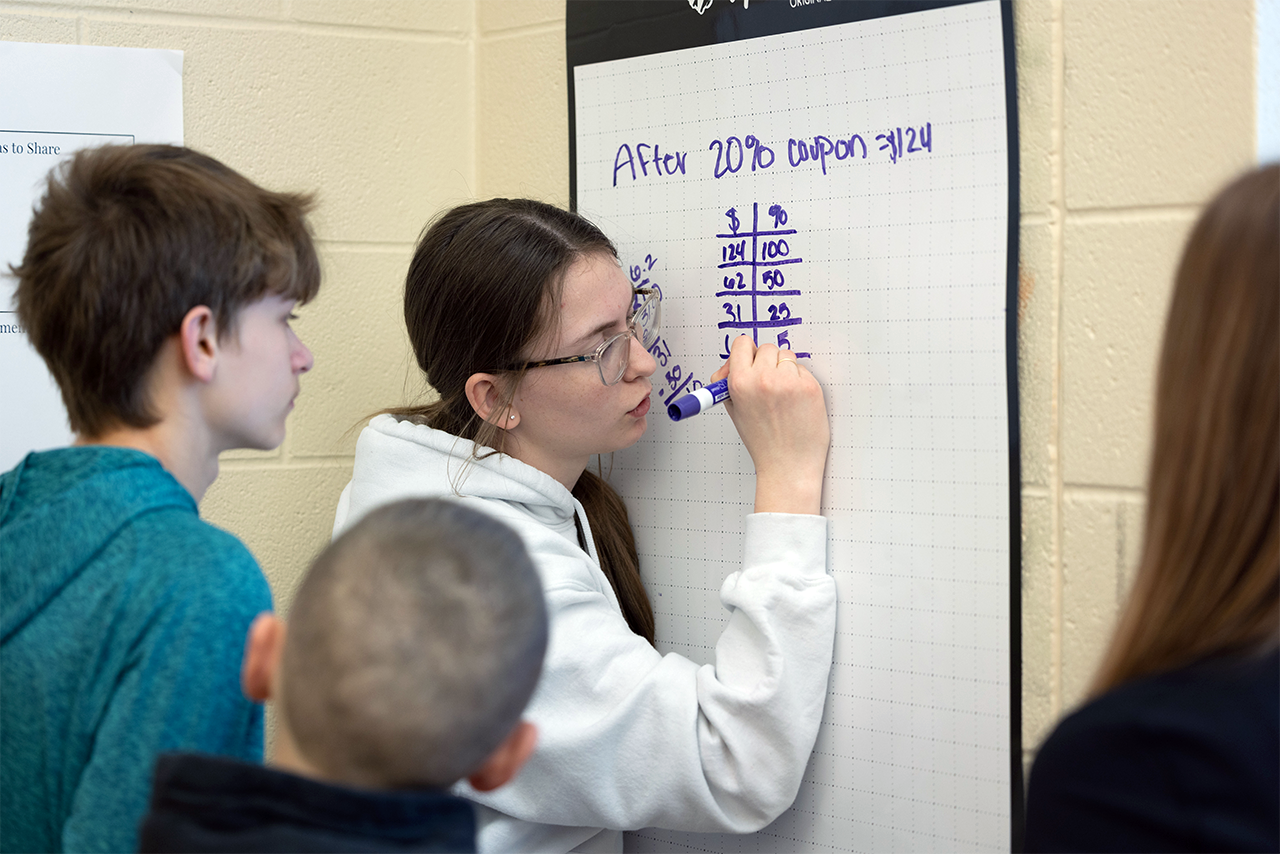
Students work in study teams of 2–4 to discuss, justify, and refine their mathematical thinking.
Problem-Based Lessons
Every lesson centers on engaging, non-routine problems that build conceptual understanding from the ground up.
Research-Grounded
Built on CPM's Three Pillars — validated by over 35 years of mathematics education research and practice.
Full Resource Ecosystem
eTools, Homework Help, Parent Guides, Mathcasts, and professional learning — all included.
Choose Your Series
Both series share CPM's research-grounded approach. The difference is in format, pacing technology, and materials. Choose the one that fits your district's needs.
Grades 6–8 · New Program
Grades 6–8 · Time-Tested
Not sure which series is right for your district?
Our team is happy to walk you through the differences and help you find the best fit.
Inspiring Connections
CPM takes a deeper look into when, where, and how to use basic skills and apply them to the world in which we live. As a 31-year veteran educator, I am now the facilitator of discussion while still guiding the students toward mathematical proficiency and knowledge.
Long-time educator, California
Inspiring Connections
Inspiring Connections is CPM's newest middle school program — a multimodal curriculum designed to use the right medium for each learning moment, whether digital, print, or hands-on.
Print & Digital Blend
Digital and print work in tandem — not as alternatives. eTools, eWorkspace, and pacing technology pair with the Mathematician's Notebook so each lesson uses the medium that serves learning best. Both are essential.
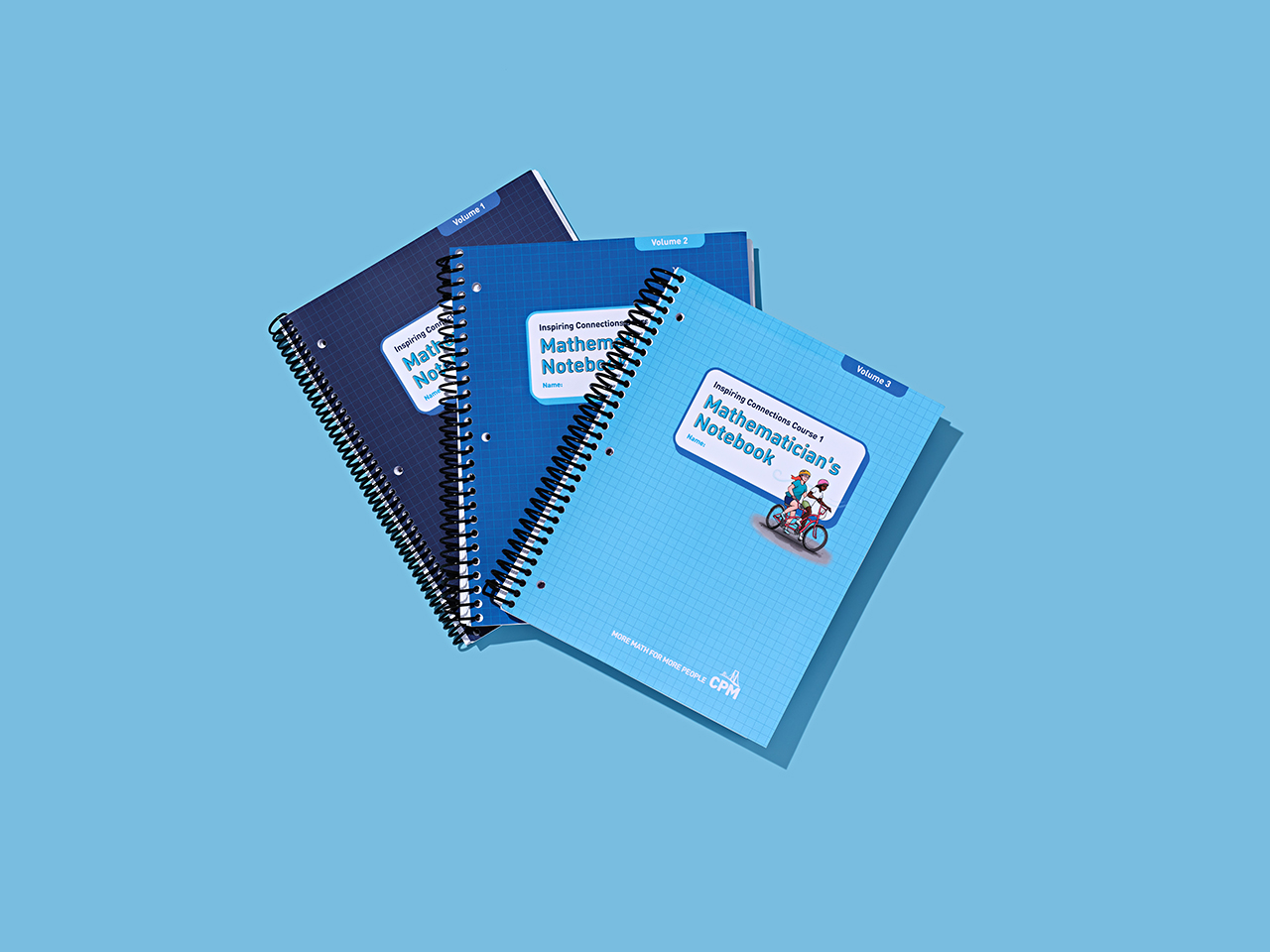
Mathematician's Notebook
A personal student companion for recording rough-draft thinking, key concepts, questions, mistakes, and inspirations. Contains diagrams, graphs, and printed Learning Targets so students can track their own progress throughout each chapter.
Variety of Venues
Lessons move students between vertical non-permanent surfaces (VNPSs), devices, manipulatives at a desk, and the Mathematician's Notebook — each venue chosen for how it best supports the learning intent of that activity.
Teacher Guides
Each lesson includes an Authors' Vision (how the lesson is intended to unfold), a Lesson at a Glance (overview, learning intent, materials, standards, additional resources), and brief reminder notes for returning to lessons.
Learning Targets
Concise goals for each lesson are presented to teachers and students in chapter introductions, referenced in Reflection & Practice problems, and revisited in Chapter Closures. Students track their progress in the Mathematician's Notebook.
Team Roles & Strategies
Four structured roles — Representative, Coordinator, Organizer, and Investigator — give every student a voice. Study Team and Teaching Strategies (STTS) are woven throughout the Authors' Vision to structure team interactions.
Lesson Sequence
Every IC lesson is designed for a 45-minute period and follows a deliberate arc from community-building through closure and independent practice.
Read more about CPM's Three-Part Lesson structure ? Download PDF
Team Roles
Students collaborate in teams for the large majority of class time. Four roles give every student a voice and make them an integral part of their team.
Representative
Coordinator
Organizer
Investigator
A variety of Study Team and Teaching Strategies (STTS) are suggested in the Authors' Vision throughout Inspiring Connections. These strategies help structure team interactions and facilitate engagement. As teachers gain experience with the curriculum and get to know their students, they develop their own go-to strategies.
Table of Contents — Inspiring Connections Courses 1–3
Core Connections
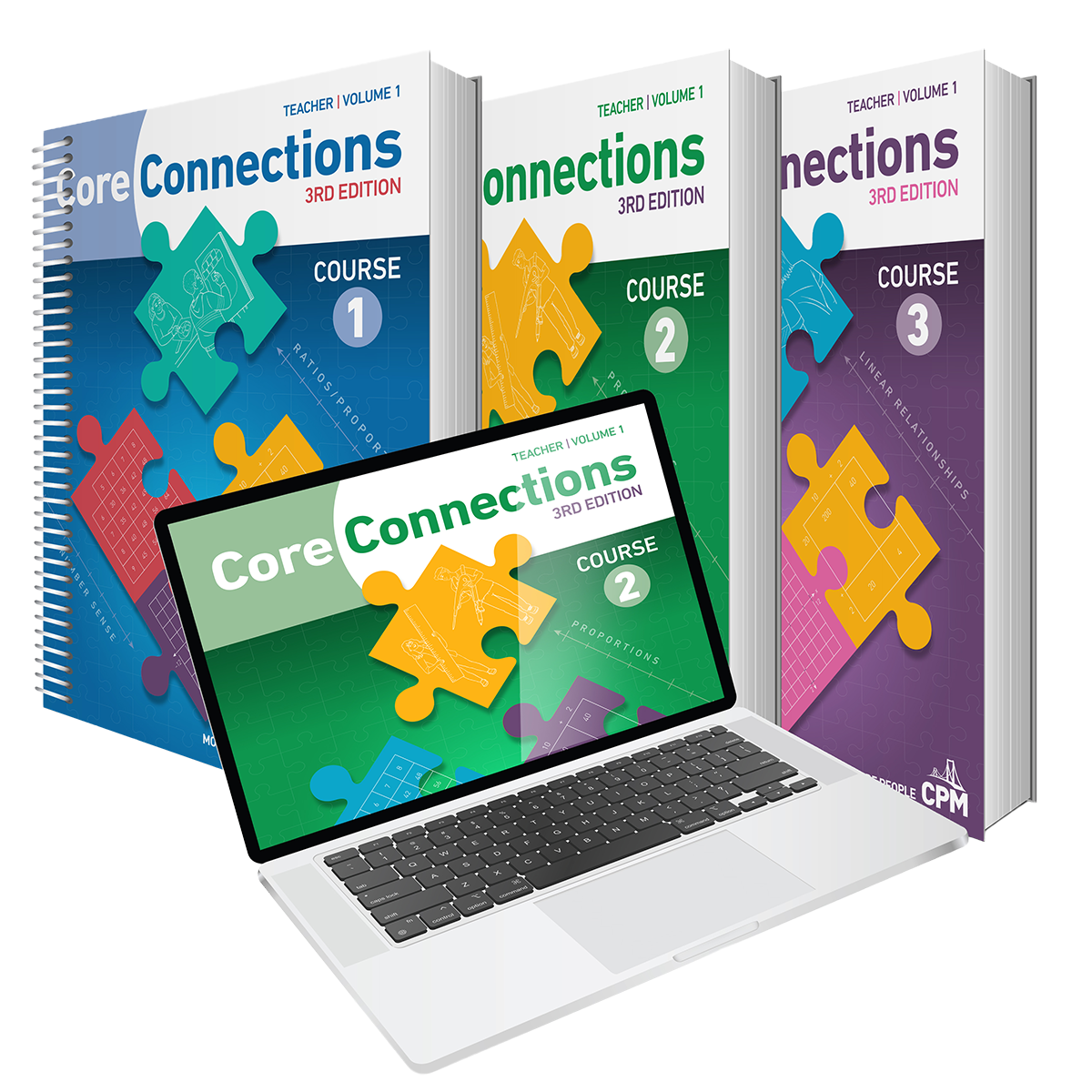
Core Connections is CPM's time-tested flagship program — refined over decades of classroom use. It delivers CPM's full research-based approach in a flexible format available in English and Spanish, digital and print.
Study Teams
Students work in teams of 2–4. Teamwork creates an environment for discussion, idea sharing, and risk-taking — a safe space for productive struggle on challenging problems.
eTools for Exploration
Virtual, interactive activities — algebra tiles, integer tiles, and other integrated digital tools — engage students and build conceptual understanding.
Learning Logs & Toolkits
Students reflect on their learning in their own words through Learning Logs. Toolkits serve as consumable personal reference documents including Math Notes and key lesson images.
Mixed Spaced Practice & Homework Help
Students re-engage with past material throughout the year. The Homework Help system (linked from the eBook) provides solved examples, hints, and references to build independence.
Puzzle Investigator
Students focus on the process of solving interesting, complex problems — developing skills to show, explain, and justify their thinking beyond just getting an answer.
Parent Guide & Mathcasts
Parent Guides help families support students at home. Lesson Mathcasts give teachers video walkthroughs of each lesson — ideal for planning, subs, or unfamiliar content.
Table of Contents — Core Connections Courses 1–3
CCSS Correlations
Support Class · Grade 8
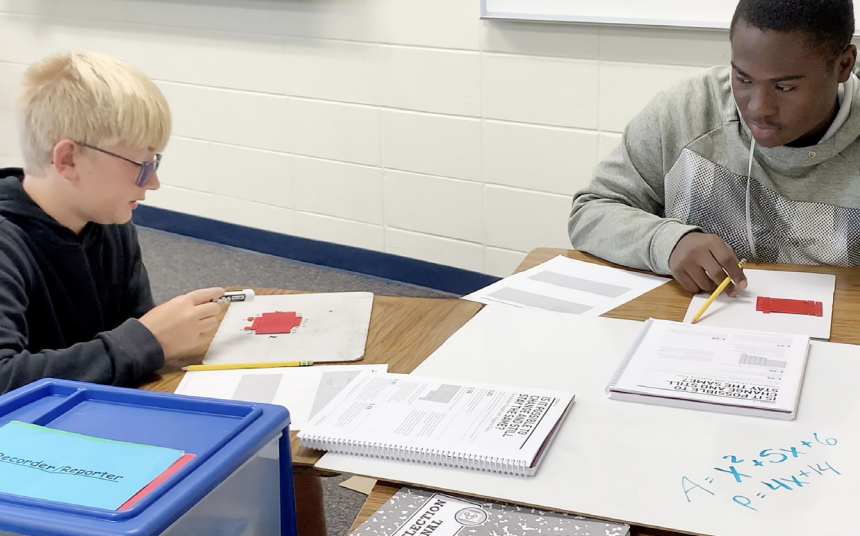
A concurrent support class for 8th graders enrolled in Core Connections Course 3 who sometimes struggle with mathematics. Rather than remediation, I&I uses math as a vehicle to change students' beliefs and attitudes — building confidence, number sense, and a genuine interest in mathematical thinking.
Course Structure
Inspirations & Ideas is a compilation of lessons arranged in units that convey multiple objectives. The course does not attempt to address every 8th grade content standard. Instead, math content is used as a vehicle to change students' beliefs and attitudes about math. Each unit may not fully address a single objective in isolation, but as a compilation the objectives are met.
This Course Focuses On
Sample Lessons
Ready to Learn More?
Connect with our team to request more information, explore curriculum samples, or shop for materials. We're happy to help you find the right program for your students.
2.3.4
Defining Concavity
4.4.1
Characteristics of Polynomial Functions
5.2.6
Semi-Log Plots
5 Closure
Closure How Can I Apply It? Activity 3
9.3.1
Transition States
9.3.2
Future and Past States
10.3.1
The Parametrization of Functions, Conics, and Their Inverses
10.3.2
Vector-Valued Functions
11.1.5
Rate of Change of Polar Functions
This professional learning is designed for teachers as they begin their implementation of CPM. This series contains multiple components and is grounded in multiple active experiences delivered over the first year. This learning experience will encourage teachers to adjust their instructional practices, expand their content knowledge, and challenge their beliefs about teaching and learning. Teachers and leaders will gain first-hand experience with CPM with emphasis on what they will be teaching. Throughout this series educators will experience the mathematics, consider instructional practices, and learn about the classroom environment necessary for a successful implementation of CPM curriculum resources.
Page 2 of the Professional Learning Progression (PDF) describes all of the components of this learning event and the additional support available. Teachers new to a course, but have previously attended Foundations for Implementation, can choose to engage in the course Content Modules in the Professional Learning Portal rather than attending the entire series of learning events again.
The Building on Instructional Practice Series consists of three different events – Building on Discourse, Building on Assessment, Building on Equity – that are designed for teachers with a minimum of one year of experience teaching with CPM instructional materials and who have completed the Foundations for Implementation Series.
In Building on Equity, participants will learn how to include equitable practices in their classroom and support traditionally underserved students in becoming leaders of their own learning. Essential questions include: How do I shift dependent learners into independent learners? How does my own math identity and cultural background impact my classroom? The focus of day one is equitable classroom culture. Participants will reflect on how their math identity and mindsets impact student learning. They will begin working on a plan for Chapter 1 that creates an equitable classroom culture. The focus of day two and three is implementing equitable tasks. Participants will develop their use of the 5 Practices for Orchestrating Meaningful Mathematical Discussions and curate strategies for supporting all students in becoming leaders of their own learning. Participants will use an equity lens to reflect on and revise their Chapter 1 lesson plans.
In Building on Assessment, participants will apply assessment research and develop methods to provide feedback to students and inform equitable assessment decisions. On day one, participants will align assessment practices with learning progressions and the principle of mastery over time as well as write assessment items. During day two, participants will develop rubrics, explore alternate types of assessment, and plan for implementation that supports student ownership. On the third day, participants will develop strategies to monitor progress and provide evidence of proficiency with identified mathematics content and practices. Participants will develop assessment action plans that will encourage continued collaboration within their learning community.
In Building on Discourse, participants will improve their ability to facilitate meaningful mathematical discourse. This learning experience will encourage participants to adjust their instructional practices in the areas of sharing math authority, developing independent learners, and the creation of equitable classroom environments. Participants will plan for student learning by using teaching practices such as posing purposeful questioning, supporting productive struggle, and facilitating meaningful mathematical discourse. In doing so, participants learn to support students collaboratively engaged with rich tasks with all elements of the Effective Mathematics Teaching Practices incorporated through intentional and reflective planning.