
Student Learning Resources

Tools and Resources to Help You Learn

Whether you’re stuck on homework, trying to understand a concept, or looking for extra practice, everything you need is right here.

2 interactive eTools7 course glossaries5 resources in your eBook
Student working on math at a whiteboard
eTools need no login

Interactive Tools

Virtual Math eTools

CPM’s interactive eTools let you build visual models of math concepts, making abstract ideas concrete and easier to understand. No login required to use them.

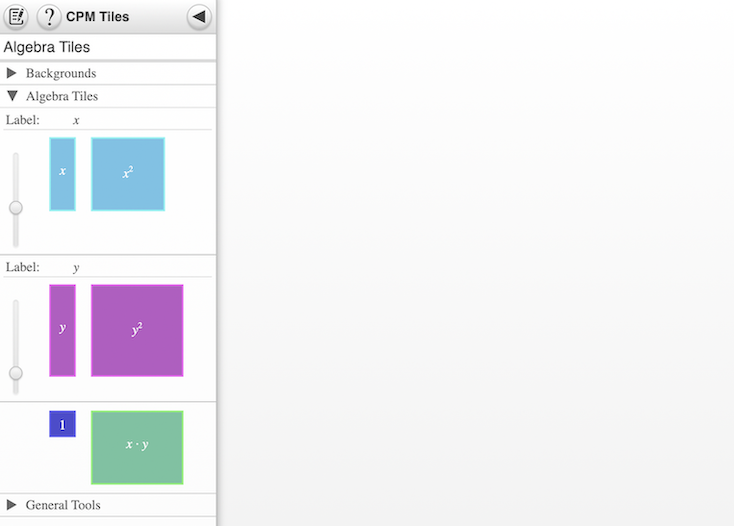
CPM Algebra Tiles eTool

CPM Tile Tool

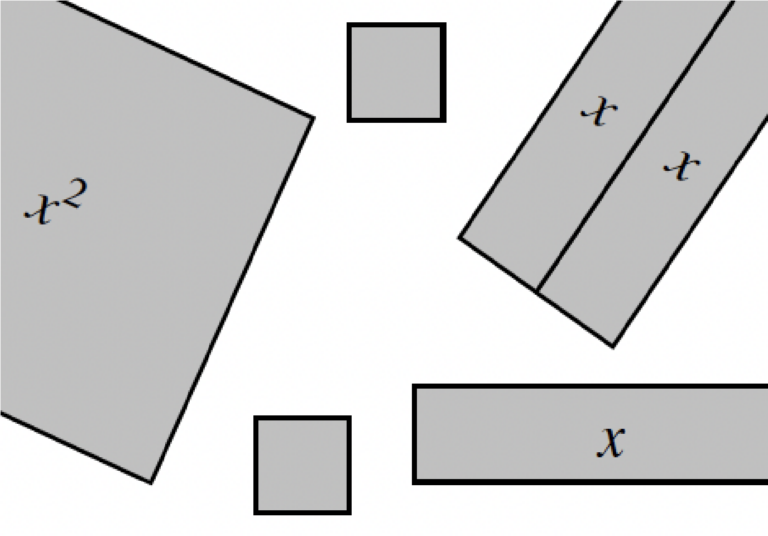
Build visual models of algebraic expressions and equations using moveable tiles. Helpful for understanding equations, factoring, multiplication, and completing the square, from middle school through calculus.

Launch Tile Tool
CPM Probability eTool

CPM Probability Tool

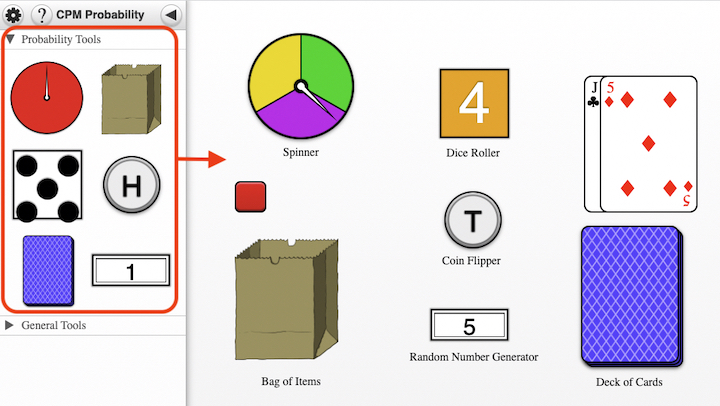
Simulate random events virtually, pick objects from a bag, flip a coin, spin a spinner, roll dice, or draw cards. Customize the tools to adjust the odds and test your probability ideas.

Launch Probability Tool

How to Use the eTools

Getting the Most from Virtual Math eTools

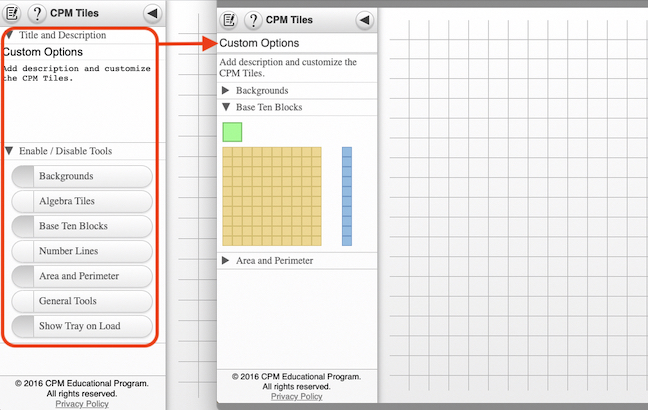
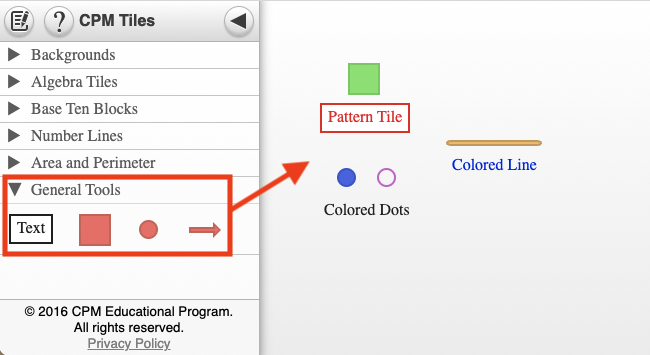
The eTools aren’t just for following along, you can customize them, build your own models, and use them to check your understanding. Here’s what they can do.

  • Construct deeper understanding
  • See visual models of concepts
  • Connect different representations
  • Create and save your own models
  • Test probability ideas instantly
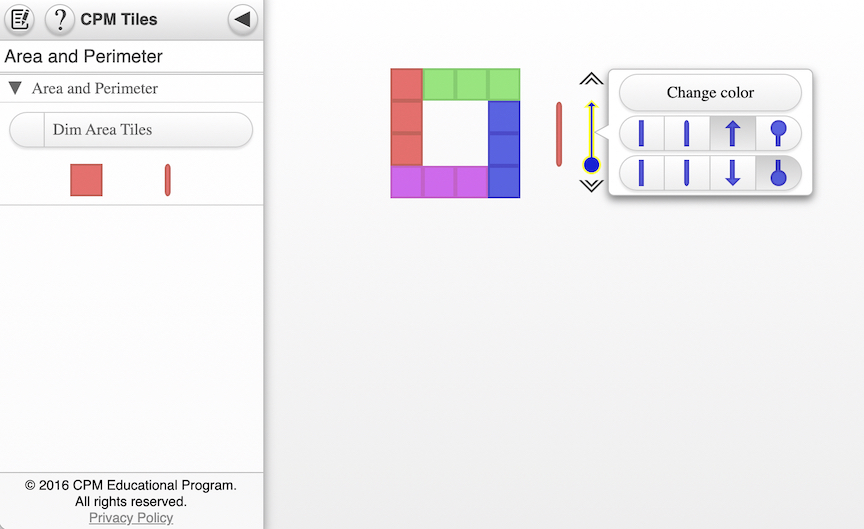
  • Explore area and perimeter

See It in Action

Discover and Explore Learning with CPM

Watch this short introduction to see how CPM’s digital tools and resources work together to support your learning, in class, at home, and everywhere in between.

Inside Your eBook

More Ways to Get Unstuck

Your CPM eBook includes five built-in resources designed to help you understand the material, check your work, and review when needed. Log in to access all of them.

Independent Practice
Practice problems designed to support mixed, spaced practice and build long-term retention. For CC3e and IC, teachers can turn answers on or off. Also available in print through the student consumable.
Access in eBook
Family Support Resources
Collections of exercises and communication around key skills, including Guided Skill Supports (CC3e), Skill Builders (IC), Checkpoints (CC3e), and Tools & Topics chapter letters (IC), to help families support learning at home.
Sample PDF
Checkpoints
Skill checks with clearly labeled topics, detailed examples, and solutions so you can self-assess your progress and identify gaps. Available in CC2e and CC3e.
View Sample
Methods & Meanings
Key definitions, formulas, and explanations placed throughout the text after concepts are introduced, a built-in reference for every topic. Called “Math Notes” in 2nd edition and “Methods & Meanings” in CC3e and IC.
Access in eBook
Toolkits & Learning Logs
Your personal working reference, includes Learning Log entries, Math Notes, and images from your student edition for notes and review.
Access in eBook

Course Glossaries

Math Vocabulary in English and Spanish

Each glossary collects the mathematical terms used in the course, with definitions and worked examples pulled from the text. Download the one for the course and keep it nearby while working through problems. No login required.

Inspiring Connections

Inspiring Connections Course 1

Inspiring Connections Course 2

Inspiring Connections Course 3

Core Connections, Middle School

Core Connections Course 1

Core Connections Course 2

Core Connections Course 3

Core Connections, High School

Core Connections Algebra

Core Connections Geometry

Core Connections Algebra 2

Core Connections Integrated

Core Connections Integrated I

Core Connections Integrated II

Core Connections Integrated III

Still Need Help?

Ask Your Teacher First

Your teacher knows your class and exactly what you are working on, so they are the best person to ask about a specific problem. When you need something outside of class, start with one of these.

Quick Reference

Words You Will See

Study team

The 2 to 4 people you work with in class. Everyone has a role, and teams change often so you work with different people.

Review & Preview

Your homework, in Core Connections. It mixes in older topics on purpose, so it will not always match what you did that day.

Reflection & Practice

Same thing as Review & Preview, but in Inspiring Connections.

Checkpoint

A skill check in your book with worked examples and answers. Good for finding out what you actually know before a test does.

Math Notes

The boxes with the definitions and formulas in them. They show up after you have worked with the idea, not before.

Methods & Meanings

The newer name for Math Notes. Same thing.

Toolkit

The notebook you build as you go, with your notes, examples, and diagrams in one place.

Mathematician’s Notebook

The Inspiring Connections version of the Toolkit.

Homework Help

Hints and steps for specific problems, inside your eBook. You need to log in.

Parent Guide

Worked examples for specific problems. In your eBook under Reference, then Student Support. Useful even if nobody at home is helping.

eTools

The drag-and-drop tools on this page. Tiles, spinners, dice, coins. No login needed.

Skill Builders

Extra practice on one topic at a time, sorted Mild, Medium, and Spicy so you can pick your level.

Guided Skill Supports

Extra practice organized by chapter, for Core Connections courses.

Rough Draft Talk

Saying an idea out loud before you are sure it is right. It is supposed to be unfinished.

Team Challenge

A test you take together with your team, usually before the individual test.

Statistics

JAVA

Calculus
Third Edition

Precalculus
Third Edition

Precalculus
Supplement

2.3.4

Defining Concavity

4.4.1

Characteristics of Polynomial Functions

5.2.6

Semi-Log Plots

5 Closure

Closure How Can I Apply It? Activity 3

9.3.1

Transition States

9.3.2

Future and Past States

10.3.1

The Parametrization of Functions, Conics, and Their Inverses

10.3.2

Vector-Valued Functions

11.1.5

Rate of Change of Polar Functions

Matemática
Integrada I

Matemática
Integrada II

Matemática
Integrada III

Integrated I

Integrated II

Integrated III

Core Connections en español, Álgebra

Core Connections en español, Geometría

Core Connections en español, Álgebra 2

Core Connections
Algebra

Core Connections Geometry

Core Connections
Algebra 2

Core Connections 1

Core Connections 2

Core Connections 3

Core Connections en español,
Curso 1
Core Connections en español,
Curso 2
Core Connections en español,
Curso 3

Inspiring Connections
Course 1

Inspiring Connections
Course 2

Inspiring Connections
Course 3

Sample Checkpoint

You are now leaving cpm.org.

Did you want to leave cpm.org?

I want to leave cpmstg.wpengine.com.

No, I want to stay on cpmstg.wpengine.com

Algebra Tiles Blue Icon

Algebra Tiles Session

  • Used throughout CPM middle and high school courses
  • Concrete, geometric representation of algebraic concepts.
  • Two-hour virtual session,
  •  Learn how students build their conceptual understanding of simplifying algebraic expressions
  • Solving equations using these tools.  
  • Determining perimeter,
  • Combining like terms,
  • Comparing expressions,
  • Solving equations
  • Use an area model to multiply polynomials,
  • Factor quadratics and other polynomials, and
  • Complete the square.
  • Support the transition from a concrete (manipulative) representation to an abstract model of mathematics.

Foundations for Implementation

This professional learning is designed for teachers as they begin their implementation of CPM. This series contains multiple components and is grounded in multiple active experiences delivered over the first year. This learning experience will encourage teachers to adjust their instructional practices, expand their content knowledge, and challenge their beliefs about teaching and learning. Teachers and leaders will gain first-hand experience with CPM with emphasis on what they will be teaching. Throughout this series educators will experience the mathematics, consider instructional practices, and learn about the classroom environment necessary for a successful implementation of CPM curriculum resources.

Page 2 of the Professional Learning Progression (PDF) describes all of the components of this learning event and the additional support available. Teachers new to a course but who have previously attended Foundations for Implementation can choose to engage in the course Content Modules in the Professional Learning Portal rather than attending the entire series of learning events again.

Building on Instructional Practice Series

The Building on Instructional Practice Series consists of three different events – Building on Discourse, Building on Assessment, Building on Equity – that are designed for teachers with a minimum of one year of experience teaching with CPM instructional materials and who have completed the Foundations for Implementation Series.

Building on Equity

In Building on Equity, participants will learn how to include equitable practices in their classroom and support traditionally underserved students in becoming leaders of their own learning. Essential questions include: How do I shift dependent learners into independent learners? How does my own math identity and cultural background impact my classroom? The focus of day one is equitable classroom culture. Participants will reflect on how their math identity and mindsets impact student learning. They will begin working on a plan for Chapter 1 that creates an equitable classroom culture. The focus of day two and three is implementing equitable tasks. Participants will develop their use of the 5 Practices for Orchestrating Meaningful Mathematical Discussions and curate strategies for supporting all students in becoming leaders of their own learning. Participants will use an equity lens to reflect on and revise their Chapter 1 lesson plans.

Building on Assessment

In Building on Assessment, participants will apply assessment research and develop methods to provide feedback to students and inform equitable assessment decisions. On day one, participants will align assessment practices with learning progressions and the principle of mastery over time as well as write assessment items. During day two, participants will develop rubrics, explore alternate types of assessment, and plan for implementation that supports student ownership. On the third day, participants will develop strategies to monitor progress and provide evidence of proficiency with identified mathematics content and practices. Participants will develop assessment action plans that will encourage continued collaboration within their learning community.

Building on Discourse

In Building on Discourse, participants will improve their ability to facilitate meaningful mathematical discourse. This learning experience will encourage participants to adjust their instructional practices in the areas of sharing math authority, developing independent learners, and the creation of equitable classroom environments. Participants will plan for student learning by using teaching practices such as posing purposeful questions, supporting productive struggle, and facilitating meaningful mathematical discourse. In doing so, participants learn to support students collaboratively engaged with rich tasks with all elements of the Effective Mathematics Teaching Practices incorporated through intentional and reflective planning.