November 2025
When Math and Joy Meet
When I tell people that joy is at the heart of the math classroom where I teach, they sometimes give me a puzzled look. Math and joy are not often words we hear in the same sentence. But when I read through student reflections this semester, one word kept coming up over and over again: joy.
And here’s the thing—this joy isn’t just a nice extra. It’s one of the reasons my students are thriving. 45% of my students met or exceeded the state math standard last year, compared to a state average of just 21%. Joy, it turns out, is a powerful driver of learning.
Collaboration and Connection
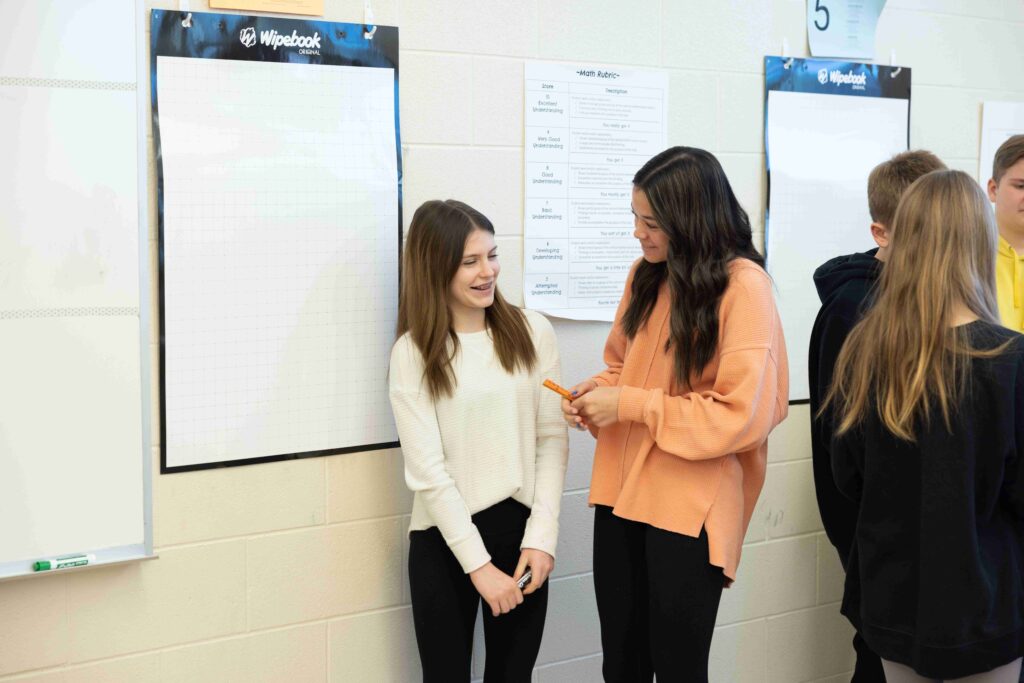
Joy in our classroom begins with community. Students sit in rotating teams every two weeks, giving everyone the chance to meet new people, collaborate, and learn from one another. Many students shared how much they enjoy the teamwork and the social energy that fills the room. They don’t just drill math problems—they work on communication, empathy, and problem-solving together.
“When we work as a team, nobody is left behind.”
“It’s fun to get to know new people every couple of weeks.”
The collaboration transforms what could be a solitary subject into a shared experience full of laughter and discovery.
Playful and Hands-On Learning
Math in the classroom isn’t about sitting still and grinding through worksheets. It’s about doing. We build marble tracks to explore motion, stack cups and dominoes to study patterns and structure, and engage in team challenges that spark curiosity and excitement. Students frequently mention how these hands-on activities make math feel alive.
“When we build with dominoes or cups, it’s fun because everyone is laughing and helping each other.”
“I felt joy when we did projects—everyone had a part in something.”
When math becomes playful, students engage deeply and naturally. They see math not as something to fear but as something to create.
Freedom, Trust, and Belonging
I find that students also value the freedom they have to learn at their own pace and the trust they feel in our classroom community. Mistakes are part of the process, not something to hide. Students have shared that they feel supported and comfortable asking questions, helping peers, and even laughing at the missteps along the way.
“I’m glad mistakes are accepted here. It’s the best learning experience I’ve had in a math class.”
“I like how this class isn’t stressful—it feels positive and supportive.”
When students feel safe and that they belong, their confidence grows—and so does their learning.
Celebration and Motivation
Joy also comes from recognition. In our class, points, leaderboards, and the classroom store aren’t gimmicks—they’re tools for motivation and connection. They help make effort visible and remind students that growth is worth celebrating.
“The points make us want to come to class and try hard.”
“It feels good when I’m at the top of the leaderboard.”
Students begin to see that success is not just about grades—it’s about effort, teamwork, and persistence.
Joy in Understanding
There’s also a quieter kind of joy. It can feel satisfying to finally understand a concept that once felt impossible. Those moments are small but powerful. I see them in the smiles when the solution for a problem clicks or when a group finishes a challenge together.
“I felt joy when I finally understood what we were doing—the work became so much easier.”
“When I got a problem right, it made me proud.”
These are the moments when confidence becomes curiosity, and curiosity leads to success.
Conclusion: Joy as a Pathway to Achievement
The joy I hear students describe isn’t accidental. By building a classroom grounded in collaboration, creativity, belonging, and celebration, I’ve seen both emotional and academic growth. When students find joy in math, they’re happier, they learn more deeply, and they achieve more highly.
In our classroom, joy and rigor coexist. And as my students continue to laugh, build, question, and explore, they remind me every day that the best kind of learning is joyful learning.