Grades 6 to 12 Mathematics
Core Connections Math Curriculum
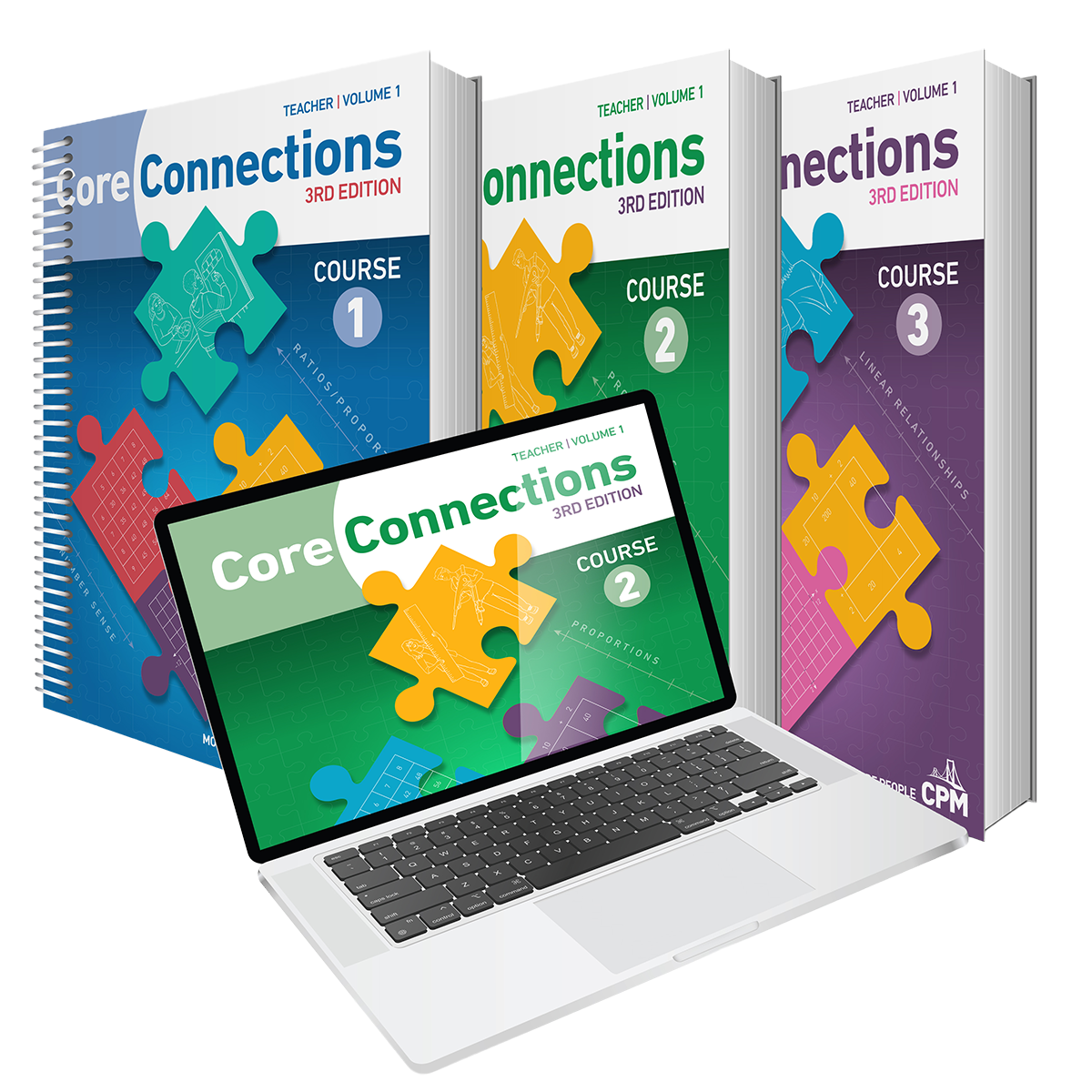
Core Connections is CPM’s research-informed mathematics curriculum for grades 6 through 12. Built on collaborative learning, problem-based lessons, and mixed, spaced practice, available in English and Spanish, digital and print.
On this page
The Approach
Built on three research-informed pillars
Every Core Connections lesson rests on three practices backed by decades of research in math education and cognitive science.
See it in action
Inside a Core Connections classroom
The routines students use, the structures teachers rely on and the resources that support families at home.
Study Teams
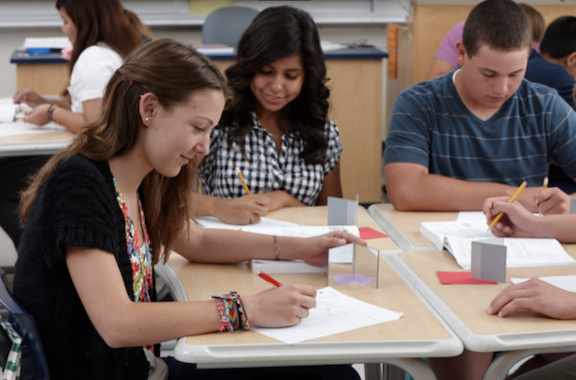
Teams of 2 to 4 create space for discussion, idea sharing and risk-taking, a safe place for productive struggle.
eTools for Exploration
Interactive algebra tiles, integer tiles and other digital tools that build conceptual understanding.
Learning Logs & Toolkits
Students reflect in their own words. Toolkits hold Math Notes and key lesson images as a personal reference.
Spaced Practice & Homework Help
Past material returns all year. Homework Help, linked from the eBook, offers solved examples, hints and references.
Puzzle Investigator
Rich, complex problems where students show, explain and justify their thinking, not just get an answer.
Parent Guides & Mathcasts
Parent Guides (2nd Edition) and Guided Skill Supports (3rd Edition) help families at home. Lesson Mathcasts walk teachers through every lesson for planning or subs.
Evidence
Proven in real districts
Independent reviews, district stories and performance reports from schools using Core Connections.
CPM takes a deeper look into when, where and how to use basic skills and apply them to the world we live in. As a 31-year veteran educator, I am now the facilitator of discussion while still guiding students toward mathematical proficiency.
Long-time educator, CaliforniaDistrict stories
Clarkston Community Schools
The benefits of collaborative, inquiry-based learning.
Read the storyWorthington City Schools
Shifting teaching toward conceptual understanding and productive struggle.
Read the storySanta Ana USD
De-mystifying standards-based teaching for emergent bilinguals.
Read the storyIndependently reviewed by EdReports
In-depth, independent reviews of instructional materials.
Performance data
How CPM schools perform on state assessments.
Pathways
Find the right course for every grade
Core Connections covers grades 6 through 12 across four flexible pathways. Choose the one that fits your district, school or student.
Middle School
Foundational reasoning built through collaborative problem-solving in study teams.
Course 1 · Course 2 · Course 3
Explore coursesHigh School Traditional
A familiar three-year sequence with CPM’s problem-based approach.
Algebra · Geometry · Algebra 2
Explore coursesHigh School Integrated
Algebra, geometry and statistics woven together each year, the way math is used in the real world.
Integrated I · II · III
Explore coursesAdvanced
Rigorous, problem-based courses that prepare students for college and careers.
Precalculus · Calculus · Statistics
Explore coursesBuilt for everyone
Support for the whole classroom community
Whether you’re teaching it, leading it or supporting a student through it, Core Connections gives you what you need.
For Teachers
Multi-year institutes, lesson-level Mathcasts, classroom-tested resources and a national community of peers.
Explore professional learningFor Administrators
Make confident curriculum decisions backed by independent research, district case studies and decades of classroom evidence.
See the researchFor Families
Parent Guides, Guided Skill Supports, Homework Help and clear explanations to support your student through every course.
Help your studentAvailability
Every language, every format
Core Connections is fully available in English and Spanish, in digital and print, with every course aligned to the Common Core State Standards.
English
Full curriculum for grades 6–12, digital and print.
Español
A full Spanish translation of every course.
Digital
Interactive eBook with eTools, Homework Help and Mathcasts.
Traditional textbooks for every course and grade.
Scope & standards
Tables of contents & CCSS correlations
Open any course to see its chapters and download its Common Core alignment documents.
Middle School
Course 1 (Grade 6)9 chapters · 3 CCSS PDFs
- Ch 1Introduction & Representation
- Ch 2Arithmetic Strategies & Area
- Ch 3Portions & Integers
- Ch 4Variables & Ratios
- Ch 5Multiplying Fractions & Area
- Ch 6Dividing & Building Expressions
- Ch 7Rates & Operations
- Ch 8Statistics & Multiplication Equations
- Ch 9Volume & Percents
Course 2 (Grade 7)9 chapters · 3 CCSS PDFs
- Ch 1Introduction & Probability
- Ch 2Fractions & Integer Addition
- Ch 3Arithmetic Properties
- Ch 4Proportions & Expressions
- Ch 5Probability & Solving Word Problems
- Ch 6Solving Inequalities & Equations
- Ch 7Proportions & Percents
- Ch 8Statistics & Angle Relationships
- Ch 9Circles & Volume
Course 3 (Grade 8)10 chapters · 3 CCSS PDFs
- Ch 1Problem Solving & Proportional Relationships
- Ch 2Simplifying with Variables
- Ch 3Graphs & Equations
- Ch 4Multiple Representations
- Ch 5Systems of Equations
- Ch 6Transformations & Similarity
- Ch 7Slope & Association
- Ch 8Exponents & Functions
- Ch 9Angles & Pythagorean Theorem
- Ch 10Surface Area & Volume
High School · Traditional
Algebra7 chapters · 3 CCSS PDFs
- •Linear, quadratic, and exponential functions
- •Multiple representations: graphs, tables, equations, contexts
- •Systems of equations and inequalities
- •Arithmetic and geometric sequences
- •Square root, absolute value, piecewise, and inverse functions
- •Statistical analysis of two-variable data
- •Regression, correlation, and residuals
Geometry7 chapters · 3 CCSS PDFs
- •Transformations and rigid motion
- •Triangle congruence and similarity
- •Right triangle trigonometry
- •Circles, arcs, and angles
- •Coordinate geometry and proof
- •Area, surface area, and volume
- •Probability and conditional probability
Algebra 27 chapters · 3 CCSS PDFs
- •Function families and transformations
- •Polynomial, rational, and radical functions
- •Exponential and logarithmic functions
- •Trigonometric functions and modeling periodic phenomena
- •Sequences, series, and complex numbers
- •Conic sections
- •Statistics, randomness, and the normal distribution
High School · Integrated
Integrated I7 chapters · 3 CCSS PDFs
- •Linear functions and equations
- •Systems of equations and inequalities
- •Sequences (arithmetic and geometric)
- •Exponential functions
- •Geometric transformations and congruence
- •Coordinate geometry
- •Statistics: one- and two-variable data analysis
Integrated II7 chapters · 3 CCSS PDFs
- •Quadratic functions and equations
- •Triangle similarity and right triangle trigonometry
- •Probability and conditional probability
- •Circle geometry and proofs
- •Surface area and volume
- •Polynomial operations and complex numbers
- •Function transformations
Integrated III7 chapters · 3 CCSS PDFs
- •Polynomial, rational, and radical functions
- •Exponential and logarithmic functions
- •Trigonometric functions and modeling
- •Series and sequences
- •Inferential statistics and sampling
- •Advanced function modeling
- •Preparation for Precalculus and Calculus
Frequently asked
About Core Connections
What is Core Connections?
Core Connections is CPM’s middle and high school math curriculum, developed and refined over decades of classroom use. It covers grades 6 through 12 and is built on three research-informed pillars: collaborative learning, problem-based learning and mixed, spaced practice.
It is available in English and Spanish, in digital and print, and aligns to the Common Core State Standards.
What grades and courses does it cover?
Grades 6 through 12. Middle school includes Courses 1, 2 and 3 (grades 6, 7 and 8). High school offers a traditional pathway (Algebra, Geometry, Algebra 2) and an integrated pathway (Integrated I, II and III). Advanced courses include Precalculus, Calculus and Statistics.
How is it different from a traditional textbook?
Traditional textbooks usually teach a concept first, then assign practice. Core Connections flips that model: students meet carefully sequenced problems first, work through them in study teams of 2 to 4, and build understanding through discussion and productive struggle.
Instead of practicing one skill in one chapter and moving on, students revisit concepts all year in varied contexts. This mixed, spaced practice supports long-term retention.
What support is there for teachers?
Every adoption includes access to CPM’s professional learning: multi-year teacher institutes, regional workshops, ongoing coaching and cohort programs like the Academy of Best Practice (ABP) and Teacher Researcher Corps (TRC). Lesson Mathcasts give video walkthroughs of every lesson, making planning and sub coverage easier.
What resources are there for students and families?
Free Parent Guides for 2nd Edition courses, and Guided Skill Supports for 3rd Edition courses, help families understand what their student is learning and how to support them. Homework Help, linked from the eBook, gives students solved examples, hints and references so they can work through challenges on their own.
Is it aligned to the Common Core State Standards?
Yes. Every course is fully aligned to the Common Core State Standards for Mathematics, including the Standards for Mathematical Practice. Correlation documents for every course are in the tables of contents above.
Get started
See Core Connections in your classroom
Request a free preview to explore sample lessons, eBook access and the resources your team needs to evaluate Core Connections. No pressure, no sales pitch.