Finishing the School Year Without Adding Stress: Your Temporary Math Coach Is Back With Ideas to Help You Cross the Finish Line!

April 2025

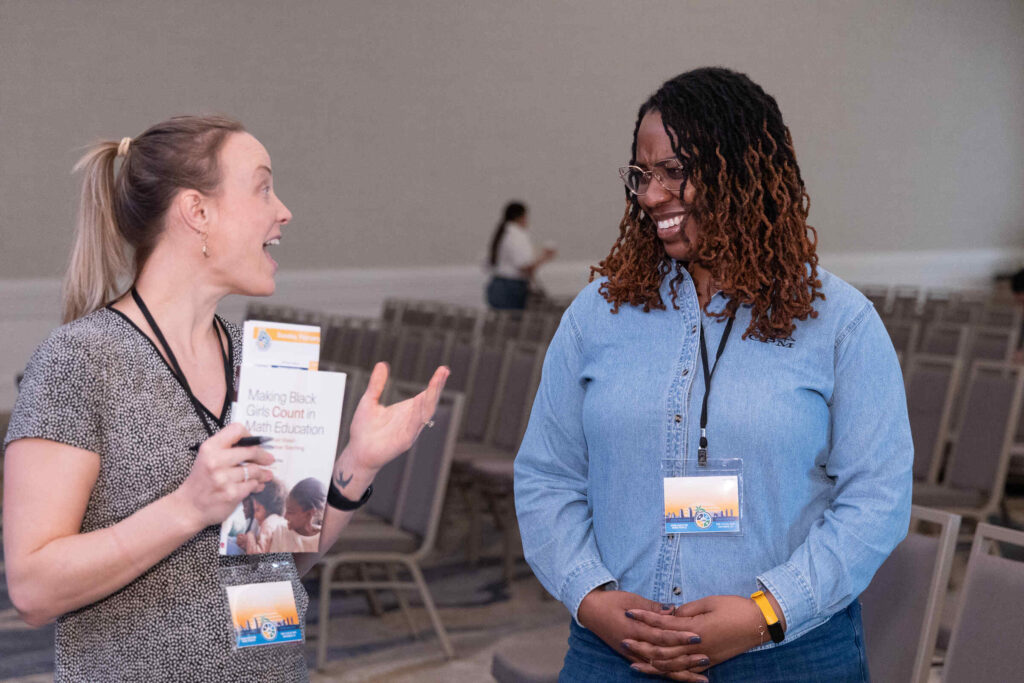
Two teachers interacting

Picture this: It is the final two weeks of school. Students are cleaning out lockers, signing yearbooks, and looking forward to celebrations and milestones. Meanwhile, in your classroom, things are flowing just as you have always envisioned—your students are engaged, collaborating, and taking ownership of their learning. The hard work you have put in all year has paid off, and your classroom feels both productive and celebratory.

Now, back to today. We are almost there. Some teachers I work with have already started backward, planning from the last day of school, mapping out the home stretch. But as the testing season wraps up, many find themselves asking, “Now what?”

What experience would you like your students to have during these final weeks? Will they be calm and bittersweet as you prepare to send students off? Will they be chaotic, filled with restless energy? Will they be joyful, reflective, and productive? If you have taught long enough, you have likely experienced all of these.

The final stretch of the school year brings both opportunity and exhaustion. Your students are feeling it. You are feeling it. This is why now is the time to work smarter, not harder—by making small shifts that keep engagement high without adding stress. How you approach these next few weeks can make the difference between just getting through and truly finishing strong.

That might mean adjusting your classroom routines to take some of the load off your plate, leaning into collaboration for fresh ideas, shaking things up with new assessment strategies, or reinforcing the student relationships that keep your classroom running smoothly. With a few intentional moves, you can create a meaningful, energized finish to the year—one that leaves both you and your students ending on a high note.

Here are some ideas to help you make that happen.


Prioritize Your Well-Being

Most importantly, take care of yourself. Teachers give so much throughout the year, and by this point, exhaustion can start to set in. Small shifts in classroom structure can help maintain engagement while also giving you the space to recharge.

  • Use team roles so students manage aspects of the lesson and take ownership of their work.
  • Lean on Study Team and Teaching Strategies like Swap Meet and Gallery Walk/Exhibit Visit so students take an active role in assessing their learning.
  • Build in peer feedback routines—students benefit from different perspectives, and it eases your load.
  • Try the Teamwork Rubric from CPM to help students hold each other accountable and build team expectations.

Shake Up Assessment Routines

By now, class routines are well established—but are they still serving students effectively? When structures become too predictable, students may disengage. The final stretch of the year is an excellent time to introduce fresh approaches to formative and summative assessments that reinvigorate learning.

  • Try a new graphic organizer, like a Magic Book or Concept Catcher, to help students structure their thinking.
  • Use vertical non-permanent surfaces (VNPS) to make problem-solving more visibly interactive.
  • Have students create portfolios showcasing key learning moments from the chapter.
  • Offer a project where students use images, drawings, or video to represent their understanding.
  • Take class outside—movement and fresh air can boost focus and engagement.

Find a Collaborative Partner

Teaching does not have to be a solo act. Collaboration fuels creativity, provides fresh perspectives, and can help bring those “I’ve always wanted to try that” ideas to life. Partnering with another teacher can make innovation feel more achievable and enjoyable.

  • Reach out to a fellow teacher in your building to co-teach or observe each other’s classes.
  • Tap into CPM resources, such as CPM’s Middle School or High School Facebook groups; there may be teachers in the CPM network open to a virtual professional learning community.
  • Follow up with a connection from a recent professional learning event—send that email!
  • Call your Math Coach (sorry, I am only temporary!) to brainstorm ideas or problem-solve together.

Strengthen Student Relationships

Classroom culture is built all year, but in these final weeks, relationships can make all the difference. Students who feel seen and valued are more engaged, more willing to take academic risks, and more invested in their learning. Now is the perfect time to reinforce those connections and celebrate the unique individuals in your classroom.

  • Start class with quick share-outs about hobbies, interests, or personal wins.
  • Incorporate reflection prompts that connect math to real-world student experiences.
  • Set up small team check-ins where students discuss their progress and challenges.
  • Celebrate student growth—acknowledge how far they have come since the start of the year.


As we near the final stretch of the school year, now is the time to refresh, reconnect, and take some risks. What is one small change you can make this week? Now that you have had a quick round of coaching, let’s make these next few weeks as engaging and rewarding as possible!


Picture of Tracy Talmage

Tracy Talmage

Detroit, MI

Statistics

JAVA

Calculus
Third Edition

Precalculus
Third Edition

Precalculus
Supplement

2.3.4

Defining Concavity

4.4.1

Characteristics of Polynomial Functions

5.2.6

Semi-Log Plots

5 Closure

Closure How Can I Apply It? Activity 3

9.3.1

Transition States

9.3.2

Future and Past States

10.3.1

The Parametrization of Functions, Conics, and Their Inverses

10.3.2

Vector-Valued Functions

11.1.5

Rate of Change of Polar Functions

Matemática
Integrada I

Matemática
Integrada II

Matemática
Integrada III

Integrated I

Integrated II

Integrated III

Core Connections en español, Álgebra

Core Connections en español, Geometría

Core Connections en español, Álgebra 2

Core Connections
Algebra

Core Connections Geometry

Core Connections
Algebra 2

Core Connections 1

Core Connections 2

Core Connections 3

Core Connections en español,
Curso 1
Core Connections en español,
Curso 2
Core Connections en español,
Curso 3

Inspiring Connections
Course 1

Inspiring Connections
Course 2

Inspiring Connections
Course 3

Sample Checkpoint

You are now leaving cpm.org.

Did you want to leave cpm.org?

I want to leave cpm.org.

No, I want to stay on cpm.org

Algebra Tiles Blue Icon
  • Used throughout CPM middle and high school courses
  • Concrete, geometric representation of algebraic concepts.
  • Two-hour virtual session,
  •  Learn how students build their conceptual understanding of simplifying algebraic expressions
  • Solving equations using these tools.  
  • Determining perimeter,
  • Combining like terms,
  • Comparing expressions,
  • Solving equations
  • Use an area model to multiply polynomials,
  • Factor quadratics and other polynomials, and
  • Complete the square.
  • Support the transition from a concrete (manipulative) representation to an abstract model of mathematics..

Foundations for Implementation

This professional learning is designed for teachers as they begin their implementation of CPM. This series contains multiple components and is grounded in multiple active experiences delivered over the first year. This learning experience will encourage teachers to adjust their instructional practices, expand their content knowledge, and challenge their beliefs about teaching and learning. Teachers and leaders will gain first-hand experience with CPM with emphasis on what they will be teaching. Throughout this series educators will experience the mathematics, consider instructional practices, and learn about the classroom environment necessary for a successful implementation of CPM curriculum resources.

Page 2 of the Professional Learning Progression (PDF) describes all of the components of this learning event and the additional support available. Teachers new to a course, but have previously attended Foundations for Implementation, can choose to engage in the course Content Modules in the Professional Learning Portal rather than attending the entire series of learning events again.

Edit Content

Building on Instructional Practice Series

The Building on Instructional Practice Series consists of three different events – Building on Discourse, Building on Assessment, Building on Equity – that are designed for teachers with a minimum of one year of experience teaching with CPM instructional materials and who have completed the Foundations for Implementation Series.

Building on Equity

In Building on Equity, participants will learn how to include equitable practices in their classroom and support traditionally underserved students in becoming leaders of their own learning. Essential questions include: How do I shift dependent learners into independent learners? How does my own math identity and cultural background impact my classroom? The focus of day one is equitable classroom culture. Participants will reflect on how their math identity and mindsets impact student learning. They will begin working on a plan for Chapter 1 that creates an equitable classroom culture. The focus of day two and three is implementing equitable tasks. Participants will develop their use of the 5 Practices for Orchestrating Meaningful Mathematical Discussions and curate strategies for supporting all students in becoming leaders of their own learning. Participants will use an equity lens to reflect on and revise their Chapter 1 lesson plans.

Building on Assessment

In Building on Assessment, participants will apply assessment research and develop methods to provide feedback to students and inform equitable assessment decisions. On day one, participants will align assessment practices with learning progressions and the principle of mastery over time as well as write assessment items. During day two, participants will develop rubrics, explore alternate types of assessment, and plan for implementation that supports student ownership. On the third day, participants will develop strategies to monitor progress and provide evidence of proficiency with identified mathematics content and practices. Participants will develop assessment action plans that will encourage continued collaboration within their learning community.

Building on Discourse

In Building on Discourse, participants will improve their ability to facilitate meaningful mathematical discourse. This learning experience will encourage participants to adjust their instructional practices in the areas of sharing math authority, developing independent learners, and the creation of equitable classroom environments. Participants will plan for student learning by using teaching practices such as posing purposeful questioning, supporting productive struggle, and facilitating meaningful mathematical discourse. In doing so, participants learn to support students collaboratively engaged with rich tasks with all elements of the Effective Mathematics Teaching Practices incorporated through intentional and reflective planning.