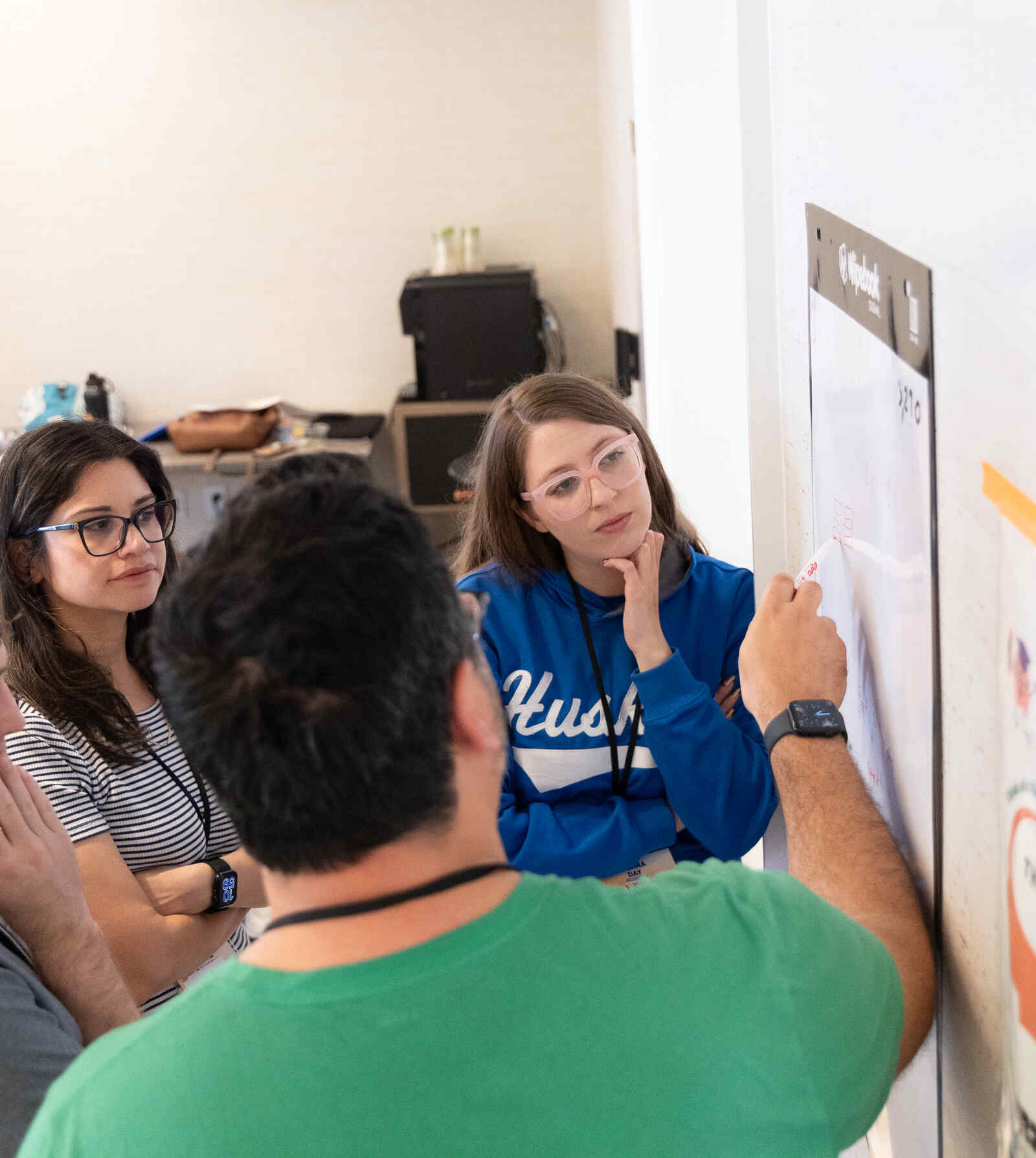
Teachers need support as they transition to a student-centered, problem-based curriculum. CPM's multi-year approach is facilitated by experienced CPM teachers — from live events and virtual sessions to on-demand modules and classroom visits.
Multi-year professional learning is built into every CPM curriculum adoption — no separate purchase required. Your teachers are supported from day one through years of ongoing growth.
Designed for teachers beginning their CPM implementation. This series contains multiple components grounded in active experiences — live sessions, collaborative problem-solving, and classroom support — delivered across the first year.
For schools and teachers with CPM experience who are ready to go deeper. Focuses on equity, assessment, and the collaborative learning strategies that define CPM classrooms at their best.
Every CPM school has a multi-year implementation plan that maps out exactly what professional learning is included — and when. See what's scheduled for your school.
Collaborate and engage directly with the mathematical content you teach.
Collaborate and engage with the mathematical storyline of the course you teach. Facilitated by an experienced CPM classroom teacher.
Schedule & registerRequired professional learning for teachers implementing CPM's Inspirations & Ideas course. Participation is required to use the materials with students.
Learn moreAccess CPM professional learning anytime through our online portal and digital tools.
CPM's Professional Learning Portal serves as the access point for online learning including both synchronous sessions and asynchronous modules.
Visit portalA formative assessment feature in CPM's online eBooks that allows students to submit work electronically and teachers to provide timely feedback.
Learn moreImplementation Support Visits (ISV) are included in year one of implementation. A CPM facilitator visits your classroom to provide individual, non-evaluative support and feedback — helping teachers connect what they've learned in PL to their daily practice.
Additional supports available for teachers and leaders at every stage.
Designed for leaders to understand the principles and practices necessary to support a successful CPM implementation at their school or district.
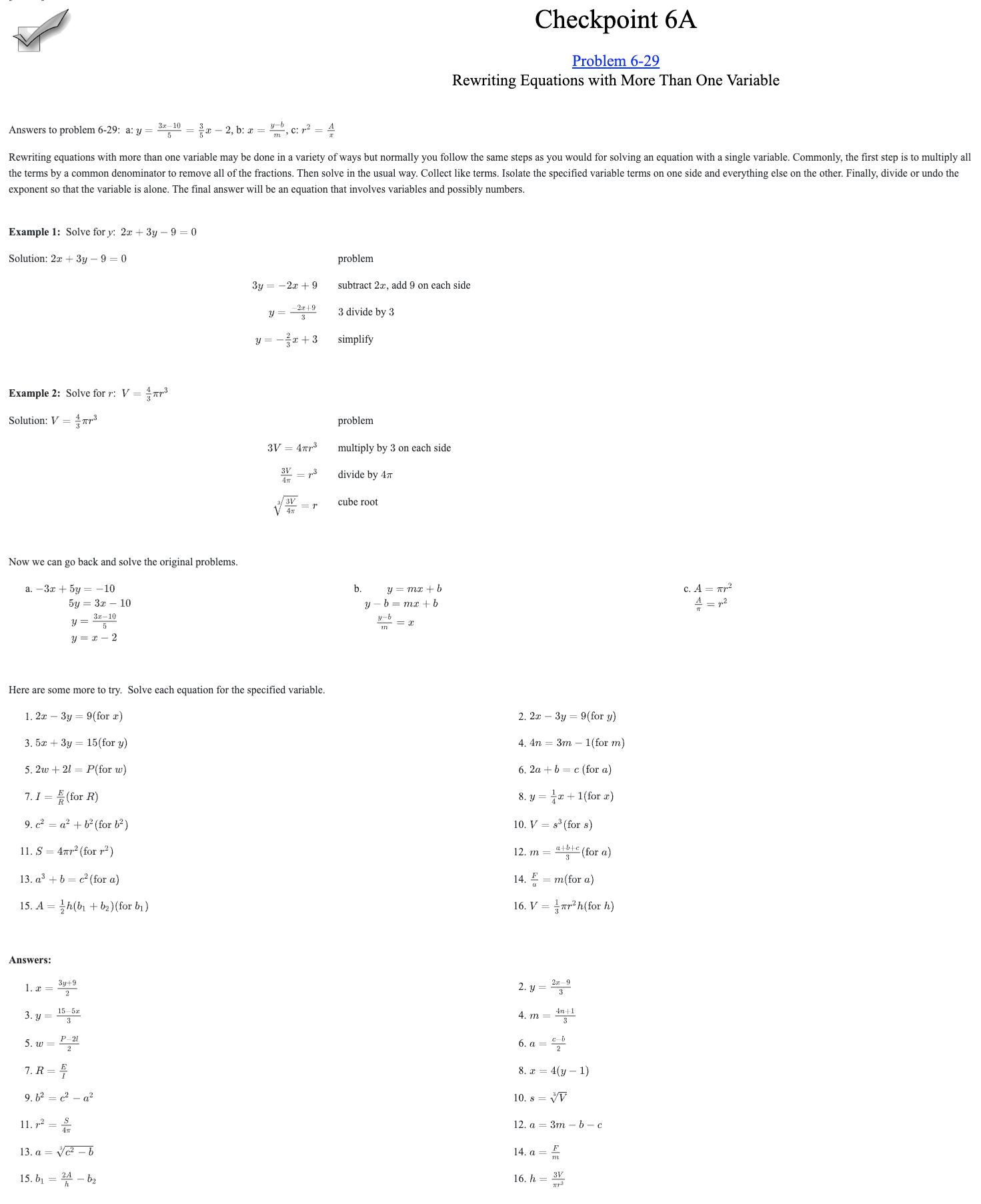
Learn moreTwo-hour virtual sessions showing how algebra tiles help students visualize mathematics geometrically — solving equations, completing the square, and moving from concrete to abstract.
RegisterCPM's PL team will work with you to develop flexible, personalized professional learning matched exactly to your school or district's needs.
Request supportResearch indicates effective coaching changes practice. CPM's coaching model includes intentional, ongoing, non-evaluative interaction between a math coach and teacher.
Learn moreTalk with our PL team about the right learning path for you, your school, or your district. We're here to help at every stage of your CPM journey.
Tell us about your school or district and we'll connect you with the right resources.
Get in touchNeed customized professional learning for your team? Submit a request to our PL Solutions team.
Submit a request2.3.4
Defining Concavity
4.4.1
Characteristics of Polynomial Functions
5.2.6
Semi-Log Plots
5 Closure
Closure How Can I Apply It? Activity 3
9.3.1
Transition States
9.3.2
Future and Past States
10.3.1
The Parametrization of Functions, Conics, and Their Inverses
10.3.2
Vector-Valued Functions
11.1.5
Rate of Change of Polar Functions
This professional learning is designed for teachers as they begin their implementation of CPM. This series contains multiple components and is grounded in multiple active experiences delivered over the first year. This learning experience will encourage teachers to adjust their instructional practices, expand their content knowledge, and challenge their beliefs about teaching and learning. Teachers and leaders will gain first-hand experience with CPM with emphasis on what they will be teaching. Throughout this series educators will experience the mathematics, consider instructional practices, and learn about the classroom environment necessary for a successful implementation of CPM curriculum resources.
Page 2 of the Professional Learning Progression (PDF) describes all of the components of this learning event and the additional support available. Teachers new to a course, but have previously attended Foundations for Implementation, can choose to engage in the course Content Modules in the Professional Learning Portal rather than attending the entire series of learning events again.
The Building on Instructional Practice Series consists of three different events – Building on Discourse, Building on Assessment, Building on Equity – that are designed for teachers with a minimum of one year of experience teaching with CPM instructional materials and who have completed the Foundations for Implementation Series.
In Building on Equity, participants will learn how to include equitable practices in their classroom and support traditionally underserved students in becoming leaders of their own learning. Essential questions include: How do I shift dependent learners into independent learners? How does my own math identity and cultural background impact my classroom? The focus of day one is equitable classroom culture. Participants will reflect on how their math identity and mindsets impact student learning. They will begin working on a plan for Chapter 1 that creates an equitable classroom culture. The focus of day two and three is implementing equitable tasks. Participants will develop their use of the 5 Practices for Orchestrating Meaningful Mathematical Discussions and curate strategies for supporting all students in becoming leaders of their own learning. Participants will use an equity lens to reflect on and revise their Chapter 1 lesson plans.
In Building on Assessment, participants will apply assessment research and develop methods to provide feedback to students and inform equitable assessment decisions. On day one, participants will align assessment practices with learning progressions and the principle of mastery over time as well as write assessment items. During day two, participants will develop rubrics, explore alternate types of assessment, and plan for implementation that supports student ownership. On the third day, participants will develop strategies to monitor progress and provide evidence of proficiency with identified mathematics content and practices. Participants will develop assessment action plans that will encourage continued collaboration within their learning community.
In Building on Discourse, participants will improve their ability to facilitate meaningful mathematical discourse. This learning experience will encourage participants to adjust their instructional practices in the areas of sharing math authority, developing independent learners, and the creation of equitable classroom environments. Participants will plan for student learning by using teaching practices such as posing purposeful questioning, supporting productive struggle, and facilitating meaningful mathematical discourse. In doing so, participants learn to support students collaboratively engaged with rich tasks with all elements of the Effective Mathematics Teaching Practices incorporated through intentional and reflective planning.