Giving Math Notebooking a Try
In general, “notebook” is a noun: a person, place, or thing.
This year, we have tried to make it a verb: an action.
This year, we are math notebooking.
To understand what we are trying this year in math class, it helps to understand what we have tried in the past. CPM provides Toolkit Math Note Pages and Toolkit Learning Log Pages that can be printed and distributed to students. Over the past several years, I have intentionally built on this idea by developing a Geometry Toolkit.

Each day in class, we began by writing a question on the whiteboard. This question served as our learning target, like an extension of the Learning Log Pages posed as a question. A few years ago, I wrote about this approach and called it the Goal of the Lesson. Students would copy this question into their Geometry Toolkit. We would then transition into exploring the core problems from a CPM lesson together. Often, the first problem or two worked well as whiteboard problems, with students standing up and working in teams. I didn’t always have students work this way, and I now realize I was missing the boat until I consistently had students working vertically.
As the lesson progressed, I kept running into the same questions. When students finish a whiteboard problem, what, if anything, should they record? When we consolidated ideas as a class, where should that thinking live? In their notebooks? Their Toolkits? Their Learning Logs?
Later in the lesson, there were usually four to six problems ideal for students to try independently: six right-triangle trigonometry problems or four systems of linear equations, for example. We would work through these problems and board-report our answers. Once again, the same questions came up: Should these problems go in the Toolkit? The Learning Log? The notebook?
On a daily basis, students asked where their work belonged.
Then came the issue of resource pages. What should we do with them? Put them in their folders? Throw them away? Copy down important information students might want to keep? And if they did keep it, where should it go: the Toolkit, the Learning Log, or the notebook?
This year, I decided to give math notebooking a try. It draws heavily on ideas I have read about Science Notebooking and brings structure and purpose to students’ written work.
The Table of Contents
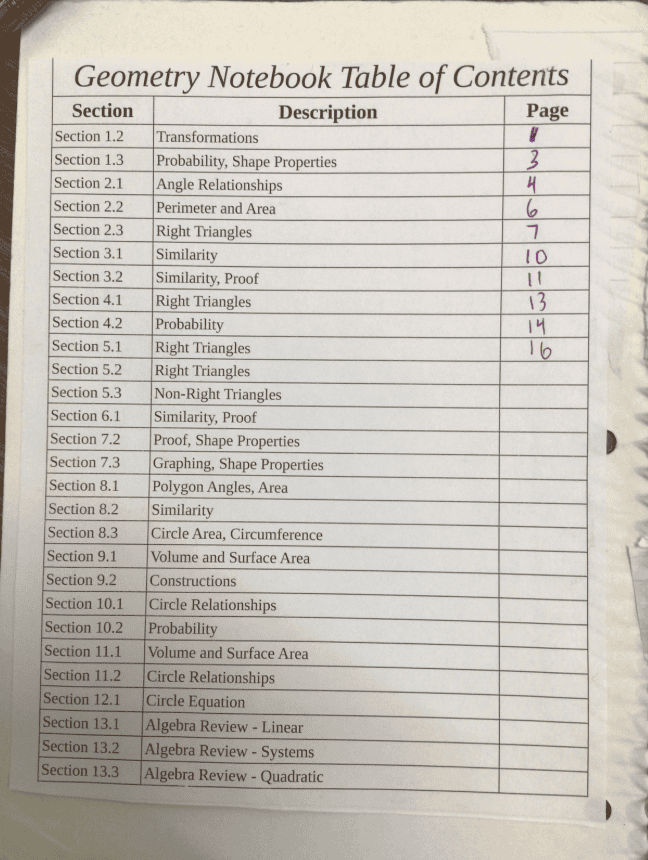
Every notebook begins with a Table of Contents, allowing students to quickly locate notes, tools, and past lessons. This turns the notebook into a reliable study guide rather than a pile of papers. Students glue or tape this to the inside front cover. During the first days of school, we number the pages of their notebooks together. Students start on page 1 and count to 10, then continue numbering pages on their own throughout the year.
Goal for the Week
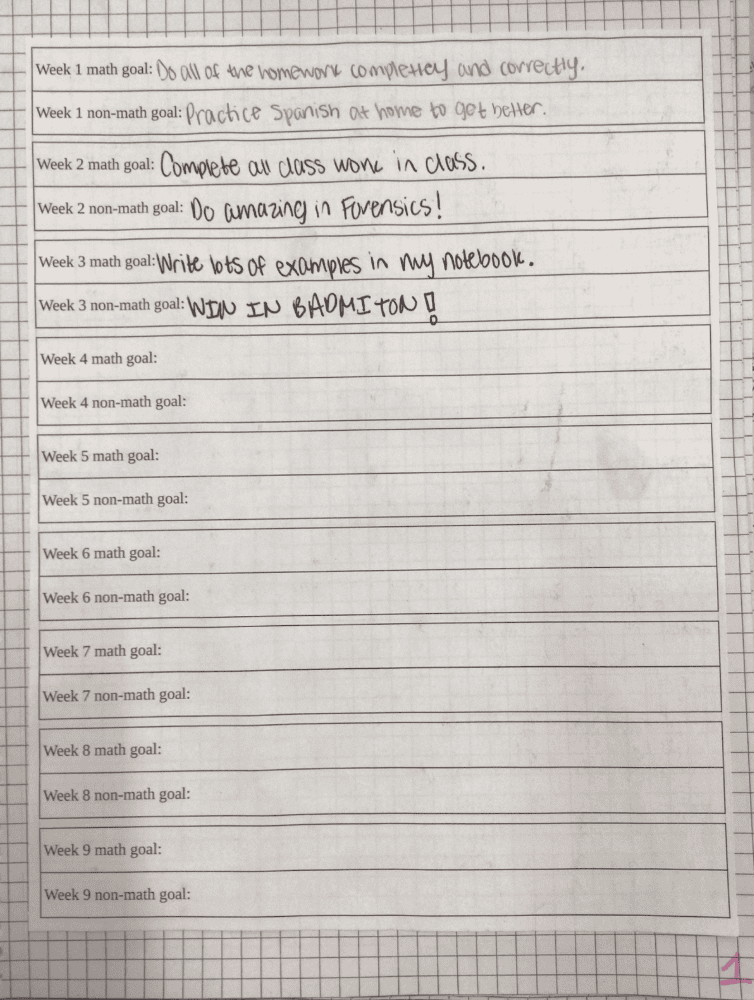
Next, students glue a goal-setting page onto the first page of their notebook. Each week, they set a math goal and a non-math goal, giving purpose to their learning and helping them focus on specific skills or habits. Every Monday morning, students take time to reflect and write new goals for the week.
Toolkit Sections
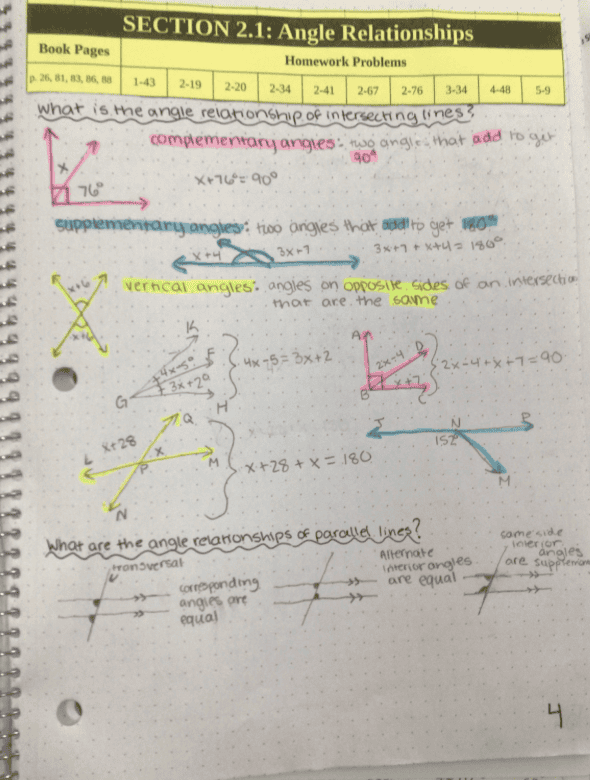
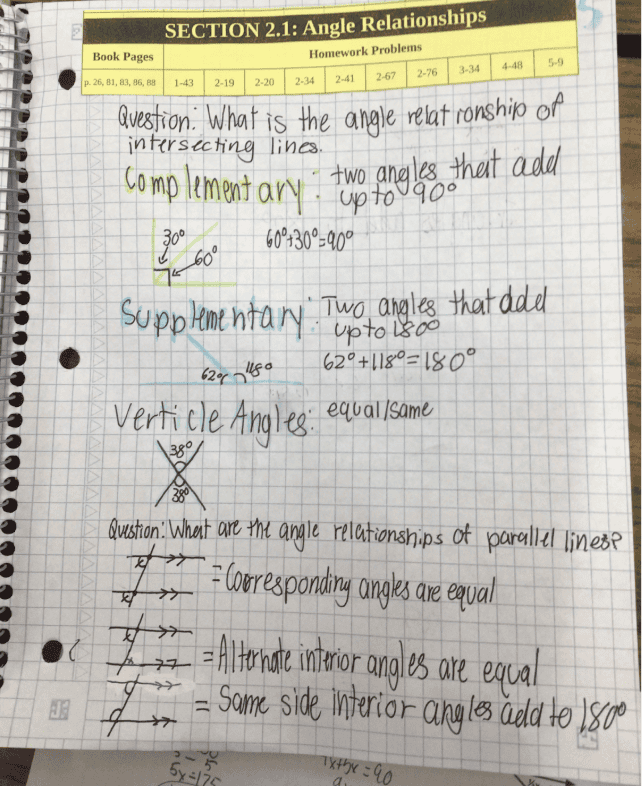
Every CPM chapter has two to three sections. For example, Section 1.2 in CCG focuses on transformations, Section 2.1 focuses on angle relationships, and Section 2.2 focuses on the area of shapes. At the start of each section, I pass out Toolkit Section Headers that students glue at the top of a page in the notebook. These Toolkit Sections mark the beginning of new content. The book pages listed provide references to Methods & Meanings boxes in the textbook, and the homework problems listed at the top serve as examples of the types of problems students should be able to complete to demonstrate proficiency in that section.
Resource Pages
What do we do with them? We figured it out.
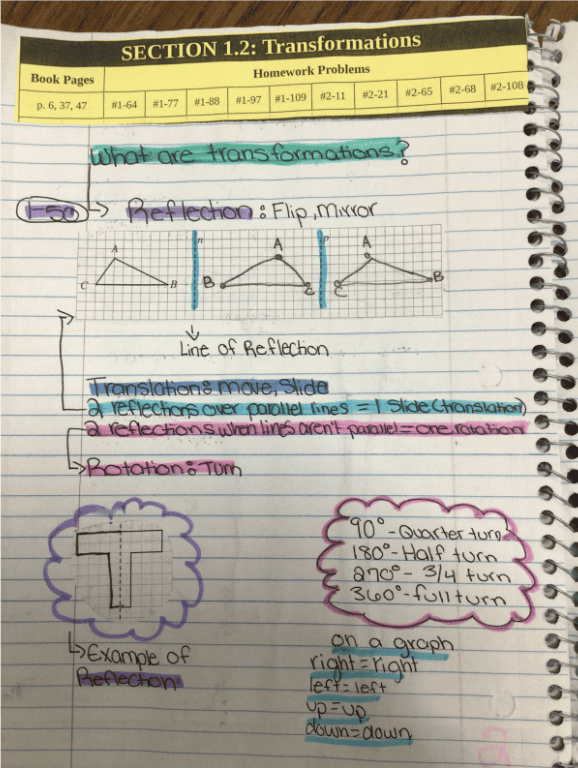
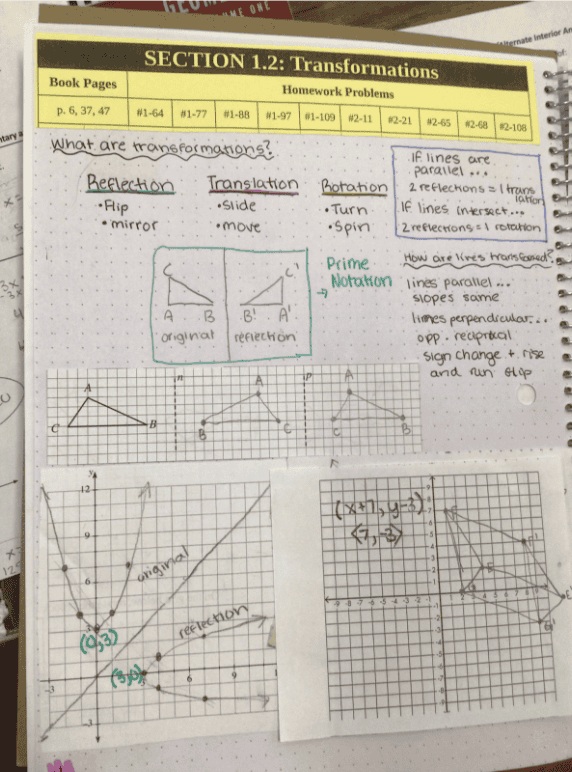
Students cut out the most useful parts and glue them directly into their notebooks. For example, students cut out portions of the 1.2.1 Resource Page on reflections and the 1.2.4 Resource Page on rotations and glued them into Section 1.2. These pages serve as clear examples of transformations and become valuable references later in the year.
Additional Resources
For Entrance Slips, Exit Tickets, and other formative assessments, students tape or glue these questions in the corresponding section as examples of rigor.
Supplies
In the room, we have eight containers with supplies that make math notebooking more efficient. When we need supplies, we ask the Resource Managers to get a supply container for the team. Each container holds scissors, glue sticks, tape, markers, and highlighters.
The Three Questions
Students often ask three questions about math class:
- When is the test?
- What’s on the test?
- Can you give me questions like what will be on the test?
The Toolkit Sections help answer questions two and three. When I tell students that Section 2.1 (Angle Relationships) will be on the test, they know exactly where to look in their notebook. They also have homework problems listed on the section header that they can use as practice and review.
Notebooking
Math Notebooking is still a work in progress, but it has already brought clarity and consistency to our daily routines. Students know where to look, what to keep, and how to study. Moving forward, I plan to refine the Toolkit Sections and build in more opportunities for students to reflect on their learning within the notebook itself. The goal is simple: to make the notebook a living document that supports understanding, organization, and long-term retention.
I feel like math notebooking (verb) has made the math notebook (noun) awesome (adjective).

Brian Ryczkowski
Keep reading
More from CPM educators

Instructional Practices
From Blackboards to Chatbots: Using AI to Strengthen Mathematical Thinking
Three CPM Teacher Researchers share how they introduced AI to their math classrooms, building student skepticism, co-creating classroom agreements, and using AI…
Instructional Practices
How Can Teachers Empower Students to Overcome Apathy?
In my last two years of teaching, I found myself starting the school year more excited and hopeful than ever. I believed…

Collaborative Learning
Rich Problems on Whiteboards: A Powerful Combination!
Transitioning to a problem-based curriculum can feel intense. I was excited when my district adopted CPM. I love the way CPM builds…