A Teacher’s Guide to Perseverance as Practice
Anne Wind, Birmingham Public Schools, Coach John Hayes, CPM PLS
Walk into many math classrooms and you might see some students disengage quickly, others wait passively for direction, and a few move ahead with minimal challenge. Issues like apathy, low motivation, inconsistent effort, and the absence of productive struggle are often treated as separate problems to solve. But what if they share a common root—and a common solution?
When classrooms are intentionally designed to cultivate perseverance, students are positioned not just to get answers, but to make sense of problems, stay engaged through difficulty, and see value in their own thinking. Rather than avoiding struggle, they begin to expect it, use it, and grow from it.
A focus on perseverance doesn’t just support one group of learners—it expands opportunities for all students. By persevering, students might gain access to meaningful entry points and sustained support. All are pushed to think more deeply and flexibly. And students who find the Standards for Mathematical Practice challenging begin to develop the habits of mind needed to reason, communicate, and persist. In this way, perseverance becomes more than a skill—it becomes the engine that drives equitable and rigorous learning in the math classroom.
What Is Productive Struggle in Math?
Productive struggle in math looks like students purposefully working through challenging problems without immediately giving up. When learners persist through difficulty, rather than waiting for a teacher to intervene, this creates an opportunity to develop the reasoning skills, confidence, and habits of mind that transfer across all areas of learning.
While struggle can become unproductive at times, teachers can help keep it productive.
At the core of the shift that elevates persistence towards sensemaking is a mental shift from “getting the answer” to “understanding deeply.”
What Does Student Perseverance Look Like in Practice?
Coach Hayes: Anne’s district was in its second year partnering with CPM for coaching support. She chose to focus on productive struggle, aiming to help her students persevere through challenging problems. Anne wanted students to feel comfortable saying, “I don’t know how to proceed,” while understanding that giving up wasn’t an option. Our conversations centered on how to encourage risk-taking when students felt stuck and how to address apathy in her math classroom.
Anne: The problems I recognized in my classroom consisted of students just sitting and waiting until someone, namely me, got them back in motion. They were learning to take risks—building the confidence to begin even when the path to a solution wasn’t yet clear. They were developing the independence needed to approach problems on their own terms. A particular student, who we will call Sheena, was perceptive enough to know when her group was stuck, and vocal enough to name it. Early in the year, that awareness sounded like this: “I’m done. I can’t do this. Let’s just leave it blank.” Another student who considered himself quite strong in math, who we will call Leo, held strong convictions and clear confidence in his thinking. This confidence was not yet an asset as it manifested itself as arguments on getting the right answer rather than on understanding.
Coach Hayes: From the previous year, Anne developed a scale to assess perseverance in her classroom, which proved especially effective in supporting peer revision of conceptual understanding. This year, she shifted that same thinking inward—using the scale to help students reflect on and strengthen their own perseverance while solving problems.
Anne: At first, we would just informally talk about the sliding scale of perseverance after a daily classwork problem.
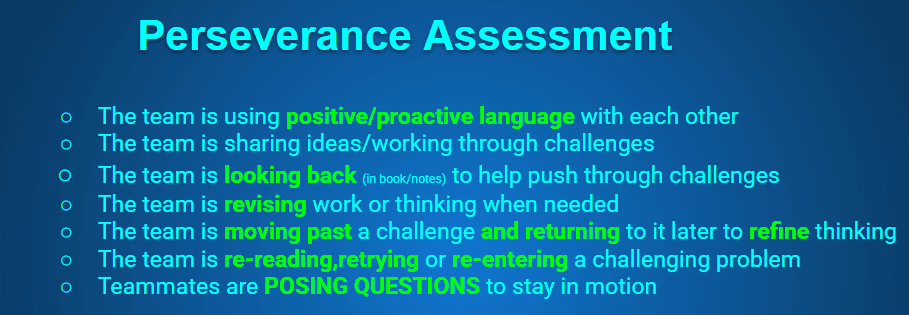
At first, we just dipped our toe in the language, and they would have team conversations about where they thought their perseverance level was with one particular problem or task that day. Then, with their third Team Performance Task (TPT) of the year, I put the scale up with all of the prompts of perseverance (see the graphic below).
During the next few TPTs, I would take notes on their behavior and write down some quotes from each team, and at the end of the TPT, I would confer with them. I would tell them all the behaviors I saw, the things I heard them say regarding perseverance that kept their group in motion. Then I would give them their “Perseverance Level” on the sliding scale, which they would write at the top of their paper.
Next, students set a written goal for themselves on their perseverance level going into the next TPT. This is when I started to see shifts in their independence and willingness. Looking back at earlier lessons and notes became a habit. Students’ discussion quality increased as they reread problems and revised solutions based on the critique of another group member. My student Sheena was actively trying to stay in motion by posing questions, rather than making statements that would halt her group. And Leo was noticeably watching his language in his group, trying to keep it positive and productive so as to not heighten the group’s angst.
This is the screen I displayed, referencing perseverance behaviors and our sliding scale:

Coach Hayes: By the spring semester, I began collecting a different kind of evidence of perseverance in Anne’s classroom—evidence grounded in language she co-developed with both me and her students. This shift made perseverance visible in students’ daily interactions. We noticed students revising their thinking after listening to teammates, referring back to notes before seeking teacher support, and asking questions to clarify understanding. They were critiquing one another’s ideas, rereading problems together, and experimenting with new representations. Their conversations included phrases like, “What if we tried…” and “At first we tried…, but it didn’t work because…, so we….” Students also used more proactive language to describe and build on each other’s thinking, signaling a deeper, shared commitment to persistence and sensemaking.
Anne: By the springtime, we were doing “Perseverance Assessments” on all TPTs and even on some days we call “Group Tasks.” I went from recording their behavior on perseverance, sharing it with them, and telling them their Perseverance Level, to having them take my evidence to come up with their own perseverance level. Sheena was showing more confidence and enthusiasm about knowing her perseverance had improved. Leo recognized his shift as he said things like, “I know I have become less combative with my team, and I try to pose questions in order to help the group discussion.”
Coach Hayes: Working with Anne reinforced that perseverance is a teachable skill. When emphasized consistently, it can address apathy, motivation, effort, and productive struggle. Anne’s focused coaching transformed both her instructional choices and her students’ capacity to learn. Her colleagues are eager to adopt her strategies, and even parents have noticed the positive impact on student learning.
Anne: This work has been some of the most inspiring work that I’ve done in my 15 years of teaching. Thanks to Coach Hayes for helping me develop and tweak the sliding scale and prompts. He really helped me narrow my focus and held me accountable for integrating this work consistently with my students.
I listen to my students every day say things like, “Maybe we should move past this and re-enter it later,” or “We need to revise this statement,” or “Wait, I think I know something we can look back to!” I hear my students say things like this, not just on TPT days, but in mundane moments. It has taken hold with my students as they work naturally through problems.
By no means are they perfect, and they still have moments of unproductive struggle and apathy. However, this structure and the concrete language and strategies to support perseverance will not only help their future math endeavors, but can also be applied in all facets of academic and non-academic life.
Why Perseverance Benefits Every Learner
This work demonstrates that cultivating perseverance in math classrooms is both intentional and transformative. By embedding perseverance into routines, language, and interactions, you can create a culture where students can engage meaningfully with challenging problems, take risks, and persist through uncertainty. Students like Sheena and Leo shifted from hesitation and waiting to actively revising their thinking, asking clarifying questions, and experimenting with new strategies—all without prompting. They began using language like “revise,” “let’s try this,” and “what if we…” naturally, signaling a deeper ownership of their learning.
Perseverance doesn’t just benefit struggling learners; it elevates the entire classroom. Students who excel are challenged to think more deeply, while those working toward the Standards for Mathematical Practice strengthen habits of reasoning, critiquing, and collaboration. A consistent focus on productive struggle reshapes not only instructional moves but also student capacity to approach problems with confidence and resilience.
This work shows that perseverance is not an abstract trait—it is a skill that can be taught, nurtured, and made visible. When teachers prioritize it, they address apathy, motivation, and effort, creating classrooms where every student has the opportunity to grow, learn, and persist.