When All You Want to Do Is Take Over, Come On Back to Student-Centered Learning & Teaching
May 27, 202616 min read
Author’s note: This submission reflects my individual classroom practice and not collaborative work from my Teacher Research Community team.
Let’s talk about the day I robbed my students of thinking.
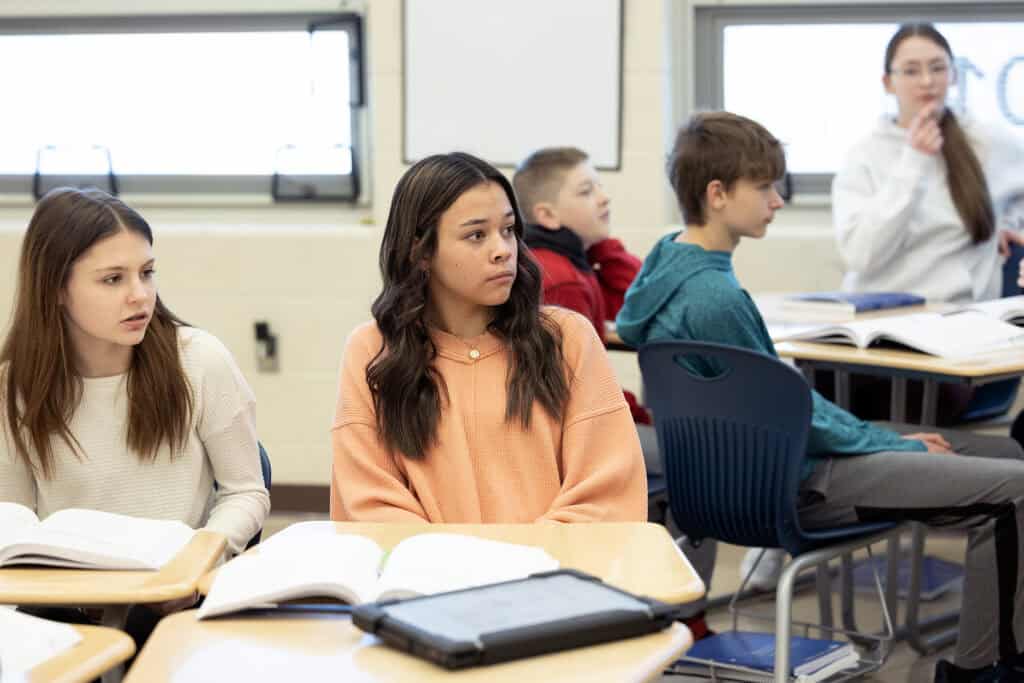
It happened during a week when we were out of our routine due to state testing. Classes were shortened, and the desks in my classroom were arranged in rows. I was teaching a chapter in Algebra 2 that I had not taught before, and I was a little bit unsure about how the lesson would go.
On normal days, students sit in groups of four at the beginning of class, and then work on lesson problems standing in random teams of three at whiteboards. For this particular lesson, students needed a resource page, so I decided to have them work with a partner, sitting at their desks. This also made it easier to move the desks together and then back to rows.
As soon as students started working on the lesson in my 3rd hour, they bombarded me with questions—frustrated because they didn’t know what to do. This was the first week back, after spring break, and we were following a different bell schedule. Were any of us ready to start thinking again?
Since classes were shortened and we were getting closer to the end of the year, I was trying to save time and energy. So I made the decision to take over the class and “walk” all students through the lesson together. Students were happy to watch me work out the problems for them, and we finished the lesson with time to spare.
I was happy because I really enjoyed the learning progression of problems and felt like I did a great job explaining how to solve inequalities. Students answered my questions energetically as they wrote down the steps in their notes.
During lunch, I talked with the other Algebra 2 teacher about the lesson, and she asked me how well students were making the connection between solving inequalities on the graph and showing the answer on a number line. She had noticed that her students needed some help making this connection. I replied that my class had no problem making the connection and that I thought that the lesson went very well.
It wasn’t until I was walking back to my classroom, ready to teach the lesson again, that I realized how wrong I was.
Students didn’t have trouble making the connection because… they didn’t have to.
By swooping in and leading my students through the lesson, I had robbed them of the opportunity to think about a problem and make connections on their own.
The next hour, I returned to the practices that I know work best for my students’ understanding. Students were working on the problems in pairs or trios, and I walked around the room, answering initial questions.
As students started to talk about the lesson, they were able to answer the problems, and I listened with intention to the conversations they were having.
Students were discussing points of intersection and where one graph was higher than the other. They were thinking about what the inequality means and how it is represented in the graph and the number line.
By the end of the hour, I could tell that the students in my 4th hour had a much better understanding of solving inequalities than those in my 3rd hour. And I was better able to assess their learning because I witnessed their thinking firsthand.
If I am being honest, the pull for me to take over and lead the class is strong. I was taught math in a very direct way. Often, it feels like this is what parents and students expect from me—even though I know it is better for students to collaborate with each other and to make connections between concepts.
On this particular day, during the 3rd third-hour class, I let my impulse to save time and to streamline the questions influence my decision to change from a student-centered lesson to a teacher-directed lesson.
What I find interesting is how good I felt about the lesson—I explained it well, and the students answered my questions enthusiastically. It wasn’t until I switched focus of the learning back to the students that I realized the truth.
Explaining a lesson well doesn’t mean the students understand the concepts.
More Situations Where Sticking With a Student-Centered Classroom May Need Extra Attention
Over the past few years, there are a few situations that have made me more likely to take over the learning. I have found that attending to specific strategies when these situations arise helps me keep myself student-centered.
“Too Many” Questions
As you can see from my story, in moments of weakness, the impulse to streamline questions pulls me toward direct instruction. When most students are asking the same question, it is easy for me to want to take over and answer it with the entire class.
The problem with taking over for one question is that it never seems to be enough. It is very easy to continue directing the entire class through the lesson.
One strategy that helps students keep ownership of their learning is a Huddle. I’ll bring one member from each team over and show them something that they can take back to their teams. This strategy focuses on students, making them the experts on their teams.
When students are at whiteboards, I often help one team, and then when another team asks a similar question, I direct them to talk to the team I just helped. Many times students will wander over to other teams to ask questions when they see work that they don’t understand.
Teaching New Material
The first time I teach a lesson, I worry that students will not be able to answer the questions on their own in teams without my help.
Whenever I find myself in this spot, I think back to what my friend and mentor, Ellen, would always say to me. “Robin, the authors know what they are doing; you need to trust the process!”
Over the last few years, I have found that she is right!
High-quality instructional materials encourage students’ thinking by design, motivating their learning through student-facing tasks that invite curiosity.
The first year I taught Core Connections Geometry, I couldn’t understand why the topic of tangent shows up before sine and cosine until I taught the lessons. Students learned about tangent by connecting it to slope! Genius! And then after they were comfortable with the concept of tangent, sine, and cosine developed naturally. It is one of my favorite lesson progressions in Geometry.
Applying Lesson Supports
From time to time, a lesson might not go as well as I hoped it would, and I want to make changes the next time I teach it. In this situation, I feel the pull to start the lesson by removing any obstacles and preteaching a concept.
But I have learned that preteaching takes away my students’ chance to think for themselves, so I try to identify why a CPM lesson did not run as smoothly as I hoped. Then I reread the lesson’s included Teacher Notes to see if there is guidance on how to adjust the lesson to address the problem. I also ask myself if there is a CPM Study Team & Teaching Strategy that might solve the issue. Usually, I’ll use a Collaborative Talk strategy to help my students work together or a Cross-Pollination strategy to help them find information for themselves when they are stuck. CPM has many STTS. I recommend finding a few of your favorites and sticking with them until you feel comfortable adding more.
Motivation Mismatch
If I am sensing a lack of motivation, that is another time I feel the pull to take over the thinking in a class.
The best way that I have found to increase motivation and perseverance when problem solving is to assign random teams of three to whiteboards. It is amazing how much thinking students are able to do when they are standing at the whiteboards!
Needing a Thought Partner
Having other teachers to learn from and reflect with is crucial. It is easy to fall into old patterns when you don’t have someone to talk to who is also focused on creating a student-centered classroom.
I would have taught both 3rd and 4th hour in the same teacher-directed way if I had not talked about the lesson with my colleague, Amanda, at lunch. She is very intentional about keeping instruction focused on students’ learning by doing, and her insight about the lesson helped me reflect more deeply on my teaching, redirecting the focus back to the students.
Over the past few years, I have enjoyed these peer conversations at my school. I appreciate having local teachers to collaborate with.
I also love that CPM has many opportunities for teachers to connect with other teachers across states. Two years ago, I became a member of the CPM Teacher Research Community, which provides me with access to a community of teachers from all over the country with whom I can collaborate on a regular basis. CPM also hosts the Academy of Best Practice for new and veteran teachers. It is a great opportunity for professional learning during the summer!
Student-Centered Is a Journey, and it’s Normal to Need to Shift Back Some Days
The next day, I made sure that students in both hours worked collaboratively on the second half of the lesson. In 3rd hour, students were able to answer the questions without too much help from me, and I was happy to hear their thoughtful conversations. At the end of the hour, they were able to explain to me how to solve an inequality rather than the other way around.
After all, teaching is a journey, and sometimes we take a wrong turn, especially when everyone is out of routine. What’s important is that we help ourselves find a way back onto the right path.
Keep reading
More from CPM educators

Teaching Strategies
Rethinking Homework with Problem Symposiums
Homework gets a bad rap. Is it really as bad as its reputation with teachers and students might indicate? Students complain that…
CPM ·

Teaching Strategies
Moving Beyond Militarized Language in Mathematics Education
This summer, CPM curriculum developer and researcher Michael Lolkus joined CPM’s Teacher Research Community (TRC) in reading Dr. Ilana Horn’s (2007) article,…
CPM ·
Teaching Strategies
Who Has Power in the Classroom?
At the start of the year, my school changed part of its mission from “empower all students“ to “help all students maximize…
Stephanie Galvez ·