How I Became a Better Teacher at the CPM Conference

Leah Gaines, Teacher Reporter, Westerville, OH

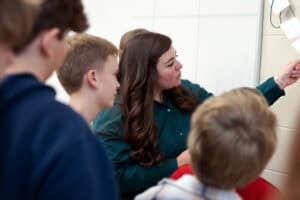
When first arriving at the CPM conference I was excited to have some time to collaborate with other teachers and learn something new; little did I know it would be so much more than that and my experience at the conference has already had a positive impact on me professionally.

Beginning with Jo Boaler, the keynote speaker, I was instantly inspired—she is so passionate about her work and research. She specifically spoke to issues that have been brought up on numerous occasions by our district’s parents and students as we have transitioned to CPM: ability grouping, students thinking they are “not good at math,” and the research behind the benefits of a growth mindset. Everything she shared with us made me a bigger believer in the fact that we are doing what is best for students and will continue to see huge growth in their learning.

Next it was on to the individual sessions. The amount of information I soaked up during these sessions was astounding. I was amazed by the scope of what can be done with Desmos, I heard of fellow teachers’ experience with a standards-based grading system, I was introduced to tech tools I can incorporate into my everyday lessons, I learned how to grade with a rubric, and how to make my grading practices fair and equitable. I could go on and on about the invaluable learning that took place. But what really solidified it for me was the chance to discuss these topics with my peers.

For the entirety of the two days I was constantly collaborating with teachers from all over America, from schools of all types and backgrounds. In true CPM fashion, this is where the true learning happened. I had the chance to internalize all of the information I had heard, was able to learn what others had learned in different sessions, and was able to compare notes and come away with so many ideas for my own classroom and school.

For me, being a teacher is summed up perfectly in the saying “you can’t see the forest for the trees.” As any teacher knows, the day-to-day grind of planning, grading, emails, and meetings makes it hard to take time out to focus on your teaching practice as a whole. I know for me personally, taking time to come to the CPM conference helped me see the forest and remember why I am a teacher.
Statistics

JAVA

Calculus
Third Edition

Precalculus
Third Edition

Precalculus
Supplement

2.3.4

Defining Concavity

4.4.1

Characteristics of Polynomial Functions

5.2.6

Semi-Log Plots

5 Closure

Closure How Can I Apply It? Activity 3

9.3.1

Transition States

9.3.2

Future and Past States

10.3.1

The Parametrization of Functions, Conics, and Their Inverses

10.3.2

Vector-Valued Functions

11.1.5

Rate of Change of Polar Functions

Matemática
Integrada I

Matemática
Integrada II

Matemática
Integrada III

Integrated I

Integrated II

Integrated III

Core Connections en español, Álgebra

Core Connections en español, Geometría

Core Connections en español, Álgebra 2

Core Connections
Algebra

Core Connections Geometry

Core Connections
Algebra 2

Core Connections 1

Core Connections 2

Core Connections 3

Core Connections en español,
Curso 1
Core Connections en español,
Curso 2
Core Connections en español,
Curso 3

Inspiring Connections
Course 1

Inspiring Connections
Course 2

Inspiring Connections
Course 3

Sample Checkpoint

Newsletter Archives

You are now leaving cpm.org.

Did you want to leave cpm.org?

I want to leave cpm.org.

No, I want to stay on cpm.org

Algebra Tiles Blue Icon

Algebra Tiles Session

  • Used throughout CPM middle and high school courses
  • Concrete, geometric representation of algebraic concepts.
  • Two-hour virtual session,
  •  Learn how students build their conceptual understanding of simplifying algebraic expressions
  • Solving equations using these tools.  
  • Determining perimeter,
  • Combining like terms,
  • Comparing expressions,
  • Solving equations
  • Use an area model to multiply polynomials,
  • Factor quadratics and other polynomials, and
  • Complete the square.
  • Support the transition from a concrete (manipulative) representation to an abstract model of mathematics.

Foundations for Implementation

This professional learning is designed for teachers as they begin their implementation of CPM. This series contains multiple components and is grounded in multiple active experiences delivered over the first year. This learning experience will encourage teachers to adjust their instructional practices, expand their content knowledge, and challenge their beliefs about teaching and learning. Teachers and leaders will gain first-hand experience with CPM with emphasis on what they will be teaching. Throughout this series educators will experience the mathematics, consider instructional practices, and learn about the classroom environment necessary for a successful implementation of CPM curriculum resources.

Page 2 of the Professional Learning Progression (PDF) describes all of the components of this learning event and the additional support available. Teachers new to a course but who have previously attended Foundations for Implementation can choose to engage in the course Content Modules in the Professional Learning Portal rather than attending the entire series of learning events again.