
From Blackboards to Chatbots: Using AI to Strengthen Mathematical Thinking
Three CPM Teacher Researchers share how they introduced AI to their math classrooms, building student skepticism, co-creating classroom agreements, and using AI to support reasoning rather than replace it.

Remarkable new technology is introduced into the school system and experts predict education will be revolutionized. The technology will, as never before, allow the widespread dissemination of new concepts and ideas that stimulate young minds and free the teacher for more creative pursuits. Yet, the magic fails to materialize, and within a few years articles appear in the popular press asserting that the failure obviously arises from the teachers not being skilled enough in the new technology.
What new technology is this New York Times article talking about?
You may be surprised to learn that it is not about artificial intelligence (AI), Google, or a personal computer, but the introduction of the blackboard in the 1840s, a piece of technology that many of us can go our entire careers without ever actually using. Nearly two centuries later, we find ourselves in a familiar moment. Once again, a powerful new tool, this time AI in the form of large language models (LLM), has entered our classrooms, with predictions that it will transform education. The question is not whether AI has potential, but how we, as math educators, choose to respond to that potential in ways that preserve and strengthen student thinking.
Rather than asking only whether students might use AI to “cheat” in the traditional sense, a more pressing concern may be how its presence reshapes the nature of learning itself, particularly whether students still engage in meaningful struggle, collaborative problem solving, and mathematical sense-making, or whether they prematurely offload cognitive demand to technology before those ideas are fully formed. Knowing both its risks and its promise, the question is not simply whether to ban it, but how to design learning environments where AI supports rather than replaces the thinking that leads to deeper understanding and stronger mathematical reasoning.
Using AI Responsibly to Expand Student Learning
We are a team of three Teacher Researchers participating in CPM’s Teacher Research Community. Each year, we investigate a problem of practice that is relevant and pressing in our classrooms. We could not think of any topic more relevant and pressing than generative artificial intelligence. Rather than shy away from it and let others figure out how to integrate it, or even if we should, we decided to jump headfirst into learning ways to integrate AI into our classrooms. We see this as an opportunity to embrace students’ curiosity and make sure they know how to use it responsibly to expand their learning from the start.
Establishing Principles Before Using Technology
Before introducing any AI tools to students, we grounded our work in a few guiding principles.
- AI should support reasoning, not replace it. We should treat AI outputs as a raw material, a starting point for critique and discussion. Just as CPM tasks invite multiple strategies, AI provides additional approaches for students to analyze, compare, and evaluate.
- Student voice and collaboration remain central. The power of a CPM classroom comes from students collaborating, testing out ideas, and building on each other’s reasoning. AI can contribute to that dialogue, but it cannot replace the energy and insight that come from peer-to-peer discourse.
- We are all learners. We committed to adding in AI activities slowly and intentionally, rather than flooding students, or ourselves, with a dozen new tools. We, along with students, must reflect on what works and what does not, and adjust as we go.
Building Skepticism Through Hallucinations
To help students become familiar with AI, we implemented a lesson called “Hallucination Detective” from AI for Education (2023). Since ChatGPT, one of the platforms we used this year, is known to hallucinate, or produce factually incorrect information, we invited students to test that claim. Each student picked a topic they considered themselves an expert in and asked ChatGPT to create ten multiple-choice questions. Their job was to fact-check the answers. Amanda’s class average came out to a 16% hallucination rate, close to the published figure of 20%.
The activity sparked rich conversation. We talked about the meaning of “trust but verify,” and how important it was to know errors are not only possible, they are likely, and what we can do to mitigate that problem.
Arriving at Classroom Agreements
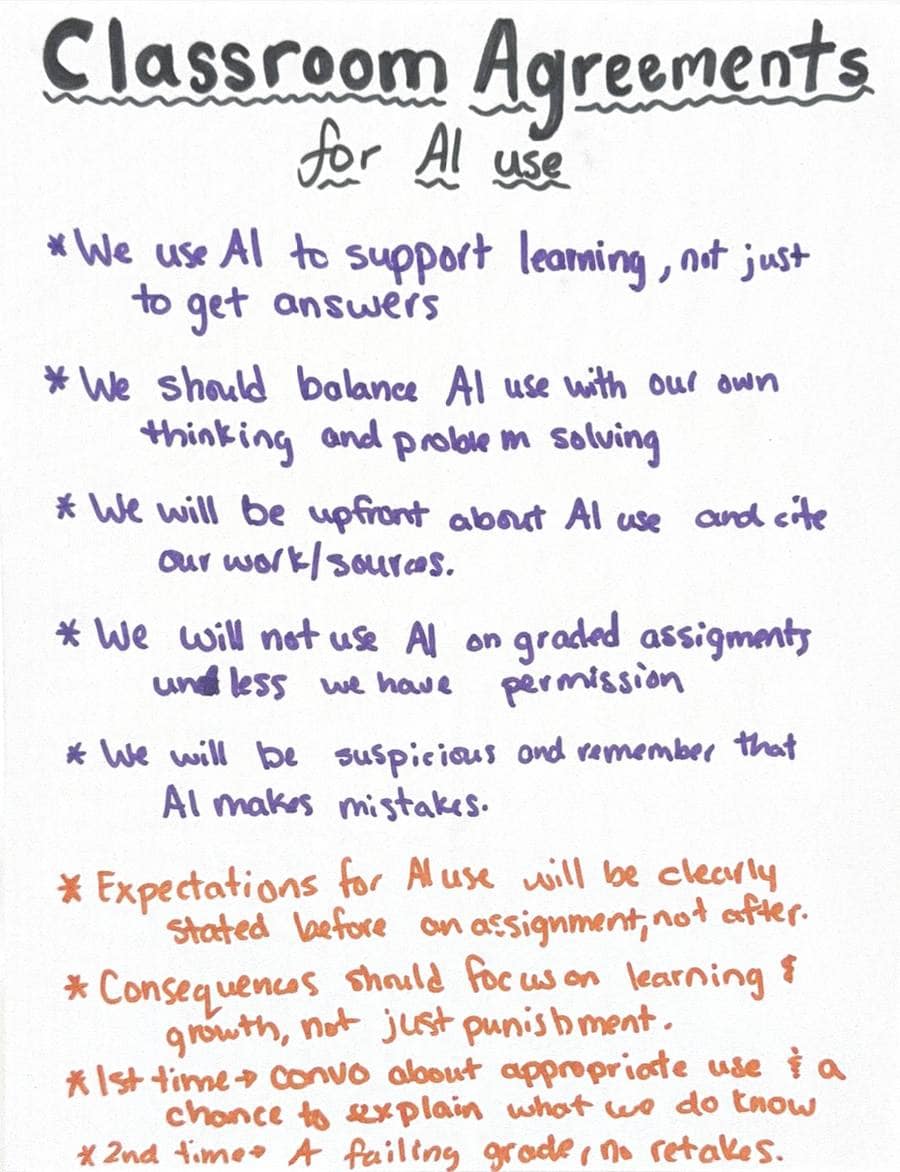
Perhaps the most important outcome of this work has been the process of co-creating classroom agreements for LLM use. Rather than imposing rules, students helped define when AI use supports or undermines learning, and what responsible AI use looks like in practice.
These conversations mirrored CPM structures around shared responsibility and reasoning. Students discussed their concerns about overrelying on AI support, and in turn not actually learning, how accurate it was, and what constitutes cheating. Students outlined acceptable uses, such as creating study guides, asking for explanations for topics they do not understand, and getting feedback, and unacceptable uses of AI, such as writing an entire essay, using it during a test, or taking away their own learning opportunity. Then students provided the consequences, starting with a kind warning and conversation about acceptable AI use, and progressing to losing AI privileges, a failing grade on the assignment, and detention or suspension. Below is an example of the classroom agreements one class developed.
From AI Skepticism to Structured Use
With a foundation of critical thinking, we began experimenting with structured classroom uses of AI.
AI as a Guided Study Partner
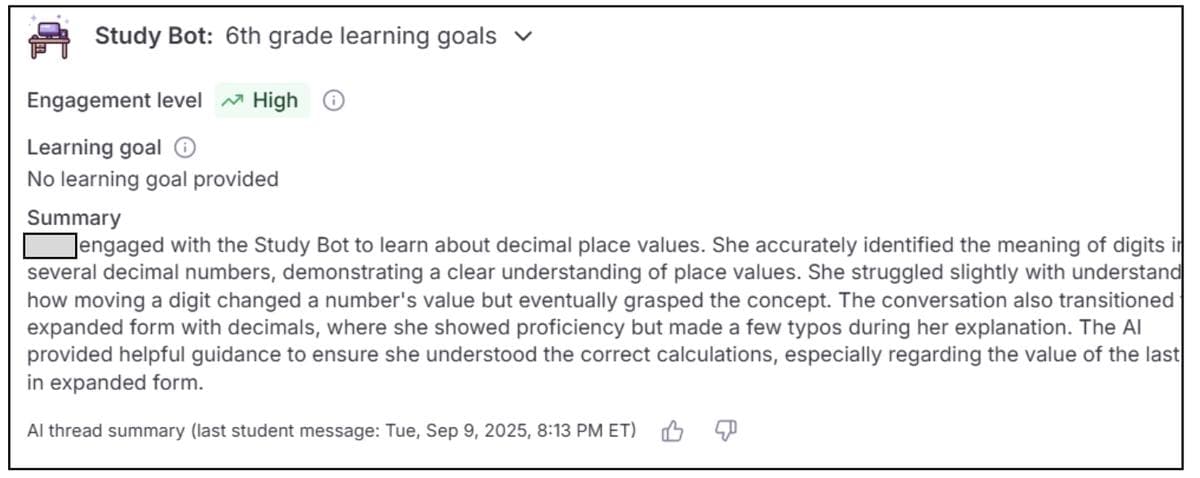
Heather started exploring MagicSchoolAI with her students, and has found it to be a great introduction to AI for middle schoolers. The more Heather has students use the study bot, the more benefits she sees. Because she can set controls on her end, everything is tailored to the sixth-grade level. The bot begins by asking students what they are currently working on, and once they provide a topic, it offers three to four ways they can continue: practice problems, word problems, or, the most common, extension activities. It even sends Heather notifications if students try to start inappropriate conversations, which has helped reinforce healthy boundaries for how they use it. The conversational nature of the study bot has resonated with students, leading some of them to use it on their own time to further their learning, as shown in Figure 1.
AI-Generated Practice Tests
In Amanda’s classrooms, students have begun using ChatGPT to generate study guides and practice tests, as shown in Figure 2. Students were required to be explicit in their prompts by defining topic, grade level, and length of response. Students take the test on their own first, without AI help. Afterward, they use the chatbot as an answer key: checking their work, noticing any discrepancies, and asking the chatbot to explain where their reasoning diverged.
Now that we have used this routine all year, students are responding to AI usage differently. Some have leaned in more than others, and several are starting to form their own judgments about when an AI tool actually helps them learn. In general, students shared that it is more useful in text-based conversations, such as asking for feedback, explaining vocabulary, and creating study guides, but less useful at creating or explaining diagrams, or going deep enough to the level of our course requirements.
Figure 2. Directions for having students create study guides using AI tools.
Station #1
Practice Test
Goal: With permission from your parent or guardian and teacher, use a school-approved AI tool to create a practice test on rigid transformations.
- Ask the AI tool to create a practice test for you. Use prompt engineering strategies.
- Be specific about the topic. Everything all at once, or one type of transformation at a time?
- Be specific about your grade level.
- Be specific about what you want. How many questions on the test?
- Complete the practice test on your own.
- Ask for an answer key and use it to check your answers. For any that do not match, be suspicious. Remember that AI can, and will, make mistakes.
- Make note of how often it gets an answer wrong.
AI as an Instructional Partner
Across this work, we found that AI is most powerful in mathematics classrooms when it is not positioned as an answer generator, but as a co-collaborator in students’ thinking. When routines are intentionally co-crafted with students, AI becomes a tool for testing ideas, analyzing errors, and strengthening mathematical explanations rather than replacing the thinking process. In this way, AI can both support and challenge learners by creating additional entry points into discourse, while also requiring students to evaluate, justify, and refine their reasoning. Importantly, these routines do not emerge automatically from the technology itself. They must be built through shared norms, structured tasks, and ongoing reflection with students.
Looking ahead, our next steps focus on refining and expanding these co-developed routines. We plan to design tasks more intentionally, where AI is embedded at specific points in the learning cycle, such as prediction, error analysis, and reflection, so that its use is consistently tied to mathematical practices rather than isolated activities. We also aim to further investigate how students independently choose when AI is helpful or unhelpful, and how those decisions shift over time as their mathematical identity and confidence grow. In addition, we will continue to refine classroom agreements as students gain more experience, ensuring that expectations for responsible and productive AI use evolve alongside their learning.
More broadly, this work suggests that AI in classrooms should not be framed as a replacement for instruction or thinking, but as an instructional partner that can deepen student engagement with mathematical ideas when used purposefully. Its value lies not in automation, but in its ability to surface thinking, prompt revision, and extend discourse when embedded in strong instructional routines.
We close with a reminder that the introduction of new educational technologies has always been accompanied by optimism, uncertainty, and high expectations for transformation. As the historical reflection from the New York Times described, new classroom technologies are often initially viewed as revolutionary, with predictions that they will reshape teaching and expand what is possible for student learning. While this reference predates the advent of AI, it captures a recurring pattern in educational change. The challenge before us is not simply whether AI belongs in classrooms, but how we choose to use it, with students, for learning, and in service of mathematical thinking.
Sources
4 references
- (2023). Lesson 3: Hallucination detective.
aiforeducation.io - (2026, January 23). When it comes to AI: Trust but verify. Forbes Technology Council.
forbes.com - (1988, August 7). Ex machina: The computer revolution revised. The New York Times.
nytimes.com - (2023, January 17). Hallucinations, plagiarism, and ChatGPT. BigDATAwire.
bigdatawire.com
Keep reading
More from CPM educators
Assessment
Giving Math Notebooking a Try
In general, “notebook” is a noun: a person, place, or thing. This year, we have tried to make it a verb: an…
Instructional Practices
How Can Teachers Empower Students to Overcome Apathy?
In my last two years of teaching, I found myself starting the school year more excited and hopeful than ever. I believed…

Collaborative Learning
Rich Problems on Whiteboards: A Powerful Combination!
Transitioning to a problem-based curriculum can feel intense. I was excited when my district adopted CPM. I love the way CPM builds…