Core Connections 3rd Edition: Updates & Upgrades to a Great Middle School Math Program

April 2025

Students at whiteboard

Core Connections has helped classrooms around the country bring More Math for More People for over a decade. Why make updates to this middle school series? Taking what we learned from the launch of CPM’s entirely new middle school program, Inspiring Connections, we realized it was time to revisit CPM’s other student-centered program.

Since the initial release of Core Connections 2nd Edition in 2012, there have been several advancements in mathematics education and in what is known about learning in general. Carol Dweck’s book Mindset was not as well-known as it, along with the idea of a “growth mindset,” is today. And Building Thinking Classrooms was still years away. 

It was time to take a well-loved, time-tested program and make it even better. Here are some of the updates and upgrades in Core Connections 3rd Edition.

New look. New format.

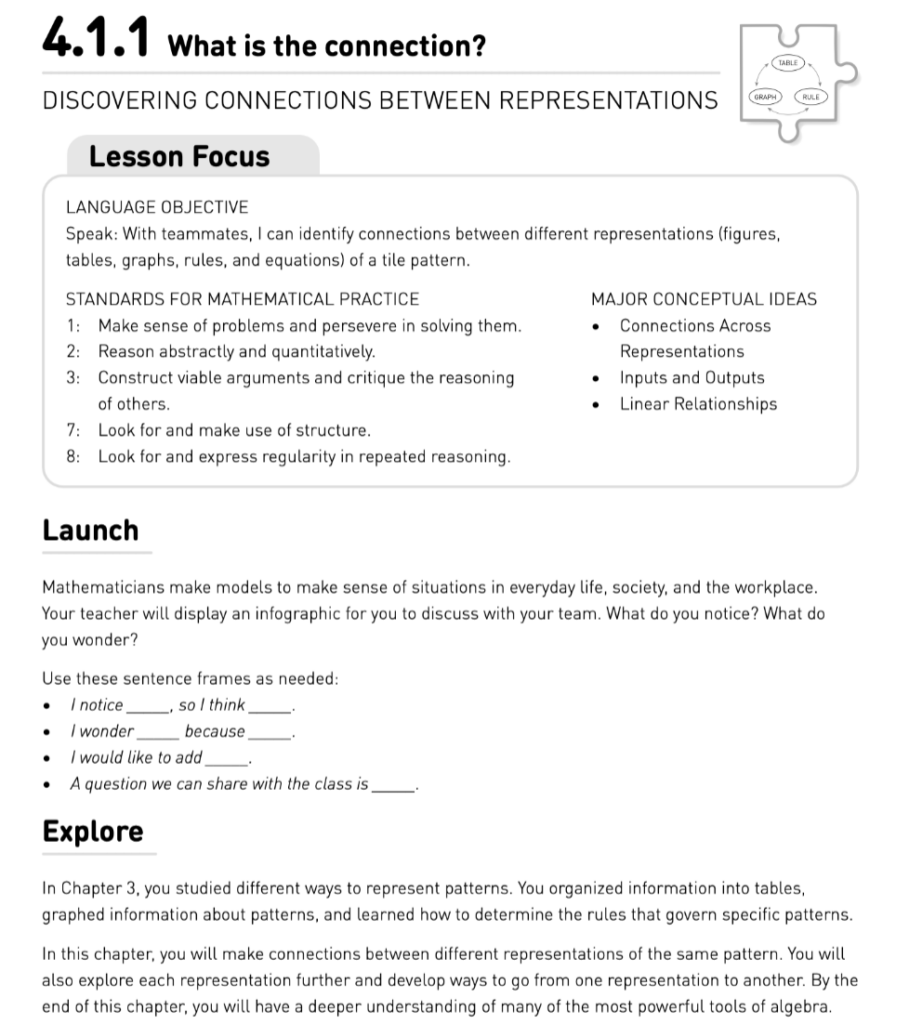
CPM has always been concerned about classroom materials being supportive and not distracting. A simple, clean look helps students stay focused. 

Core Connections 3rd Edition. © CPM Educational Program 2025. All rights reserved. Used with permission.

Every lesson now includes a Lesson Focus box. This box highlights the Standards for Mathematical Practices and Major Conceptual Ideas within the lesson, and it provides a Language Objective to support all students in accessing the academic language of the math classroom.

Launch, Explore, Closure.

Every lesson begins with a dedicated Launch, moves into the Explore, and ends with the Closure. The Launch is a quick activity to spark students’ thinking and prime their brains for learning. Launches include Math Chats, Which One is Unique?, Data Chats, and others. The Explore section is filled with the team-worthy tasks you love from CPM. The names of team roles have been updated, as have some of the Study Team and Teaching Strategies. New routines, like math language routines and teaching routines, have been added, and some lessons now have students working with their teams at Vertical, Non-Permanent Surfaces (VNPSs). Closures include Reflection Journal prompts and Goal Journal prompts. Students also write about how they are learning and the role mistakes play in their learning, and they contemplate what a growth mindset means to them. 

Print textbook. Optional consumable.

The student text is a hardbound book, but there is an optional consumable piece for the student called the Toolkit. The Toolkit contains the Methods & Meanings boxes with math notes, the Review & Preview problems with space to work, and the glossary. It does not contain the core problems written to be done with teams during class time.

Powerful Professional Learning.

CPM’s Core Connections 3rd Edition middle school series still comes with CPM’s powerful professional learning. Teachers are supported from the beginning, learning about the best practices to support student learning. 

If you are eager to take a look, contact the CPM team today!

Picture of Karen Wootton

Karen Wootton

Director of Curriculum & Assessment

Statistics

JAVA

Calculus
Third Edition

Precalculus
Third Edition

Precalculus
Supplement

2.3.4

Defining Concavity

4.4.1

Characteristics of Polynomial Functions

5.2.6

Semi-Log Plots

5 Closure

Closure How Can I Apply It? Activity 3

9.3.1

Transition States

9.3.2

Future and Past States

10.3.1

The Parametrization of Functions, Conics, and Their Inverses

10.3.2

Vector-Valued Functions

11.1.5

Rate of Change of Polar Functions

Matemática
Integrada I

Matemática
Integrada II

Matemática
Integrada III

Integrated I

Integrated II

Integrated III

Core Connections en español, Álgebra

Core Connections en español, Geometría

Core Connections en español, Álgebra 2

Core Connections
Algebra

Core Connections Geometry

Core Connections
Algebra 2

Core Connections 1

Core Connections 2

Core Connections 3

Core Connections en español,
Curso 1
Core Connections en español,
Curso 2
Core Connections en español,
Curso 3

Inspiring Connections
Course 1

Inspiring Connections
Course 2

Inspiring Connections
Course 3

Sample Checkpoint

You are now leaving cpm.org.

Did you want to leave cpm.org?

I want to leave cpm.org.

No, I want to stay on cpm.org

Algebra Tiles Blue Icon
  • Used throughout CPM middle and high school courses
  • Concrete, geometric representation of algebraic concepts.
  • Two-hour virtual session,
  •  Learn how students build their conceptual understanding of simplifying algebraic expressions
  • Solving equations using these tools.  
  • Determining perimeter,
  • Combining like terms,
  • Comparing expressions,
  • Solving equations
  • Use an area model to multiply polynomials,
  • Factor quadratics and other polynomials, and
  • Complete the square.
  • Support the transition from a concrete (manipulative) representation to an abstract model of mathematics..

Foundations for Implementation

This professional learning is designed for teachers as they begin their implementation of CPM. This series contains multiple components and is grounded in multiple active experiences delivered over the first year. This learning experience will encourage teachers to adjust their instructional practices, expand their content knowledge, and challenge their beliefs about teaching and learning. Teachers and leaders will gain first-hand experience with CPM with emphasis on what they will be teaching. Throughout this series educators will experience the mathematics, consider instructional practices, and learn about the classroom environment necessary for a successful implementation of CPM curriculum resources.

Page 2 of the Professional Learning Progression (PDF) describes all of the components of this learning event and the additional support available. Teachers new to a course, but have previously attended Foundations for Implementation, can choose to engage in the course Content Modules in the Professional Learning Portal rather than attending the entire series of learning events again.

Edit Content

Building on Instructional Practice Series

The Building on Instructional Practice Series consists of three different events – Building on Discourse, Building on Assessment, Building on Equity – that are designed for teachers with a minimum of one year of experience teaching with CPM instructional materials and who have completed the Foundations for Implementation Series.

Building on Equity

In Building on Equity, participants will learn how to include equitable practices in their classroom and support traditionally underserved students in becoming leaders of their own learning. Essential questions include: How do I shift dependent learners into independent learners? How does my own math identity and cultural background impact my classroom? The focus of day one is equitable classroom culture. Participants will reflect on how their math identity and mindsets impact student learning. They will begin working on a plan for Chapter 1 that creates an equitable classroom culture. The focus of day two and three is implementing equitable tasks. Participants will develop their use of the 5 Practices for Orchestrating Meaningful Mathematical Discussions and curate strategies for supporting all students in becoming leaders of their own learning. Participants will use an equity lens to reflect on and revise their Chapter 1 lesson plans.

Building on Assessment

In Building on Assessment, participants will apply assessment research and develop methods to provide feedback to students and inform equitable assessment decisions. On day one, participants will align assessment practices with learning progressions and the principle of mastery over time as well as write assessment items. During day two, participants will develop rubrics, explore alternate types of assessment, and plan for implementation that supports student ownership. On the third day, participants will develop strategies to monitor progress and provide evidence of proficiency with identified mathematics content and practices. Participants will develop assessment action plans that will encourage continued collaboration within their learning community.

Building on Discourse

In Building on Discourse, participants will improve their ability to facilitate meaningful mathematical discourse. This learning experience will encourage participants to adjust their instructional practices in the areas of sharing math authority, developing independent learners, and the creation of equitable classroom environments. Participants will plan for student learning by using teaching practices such as posing purposeful questioning, supporting productive struggle, and facilitating meaningful mathematical discourse. In doing so, participants learn to support students collaboratively engaged with rich tasks with all elements of the Effective Mathematics Teaching Practices incorporated through intentional and reflective planning.